Whole embryo imaging
Posted in Hardware
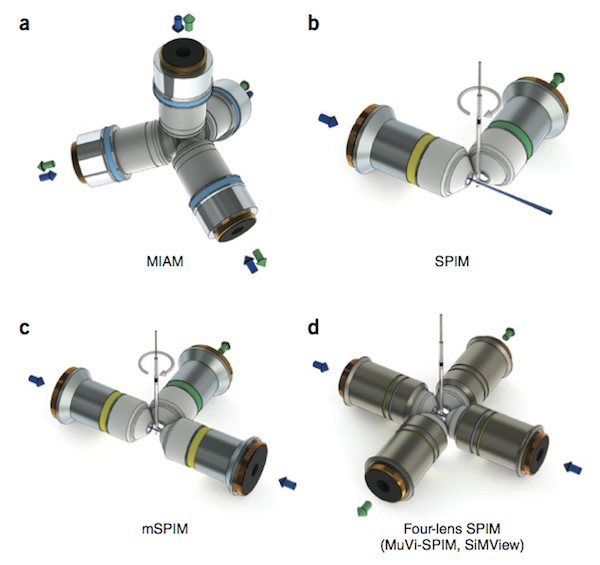
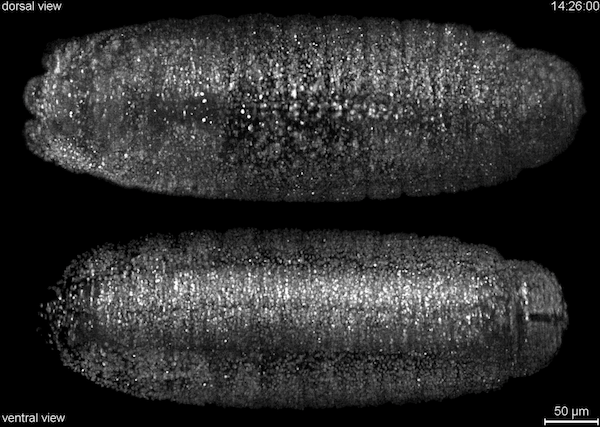
Drosophila embryos are a fraction of a square mm, and go from fertilization to hatching (as a larva) in about 22 hrs. So it’s possible to image individual embryos in their entirety with minute or sub-minute level temporal resolution (each 3D snapshot takes about 30-500 seconds, depending on method and resolution).
A couple of papers exploring whole embryo imaging appear in the latest Nature Methods. The accompanying N&V does a nice job of summarizing the different approaches. Check out some of the movies. They’re spectacular.
Amazing!
[…] From Labrigger […]
Hi,
Recetnly you have written about high NA, long working distance objectives. Do you know how one can calculate the working distance of a objective?
Htwe- If you have the objective, measure it: bringing a sample into focus and then measure the distance. If you don’t have the objective, as the manufacturer for the information.
Thanks for the reply. I do know that manufacturer provides the working distances of their objectives. But what I would like to know is how they get that information, empirically or through the formulas.
It’s a design feature. It can be computed, of course, but the calculation can be very complex and require detailed knowledge of internal component lenses of the objective. The designers can use ZEMAX or similar software to model the lens and find the working distance.