It is Snel’s law, not Snell’s law, and actually really Sahl’s law
Maybe you learned that his name was Snell. It wasn’t.
Let me back up. Electromagnetic waves propagate at about 3 x 10^8 meters per second in vacuum. We often call that number “c“. When those waves have frequencies around 400 – 800 terahertz, we call them visible light.
When those waves go through materials like glass, they slow down. Their speed is c/n, where n is typically > 1 and is called the index of refraction. When a light wave hits a surface at an angle, this decrease in speed leads also to a change in angle. You know this intuitively, just like people thousands of years ago did. You know as you look into water, the things you see under the surface of the water are a little bit deeper and closer to you than they look.
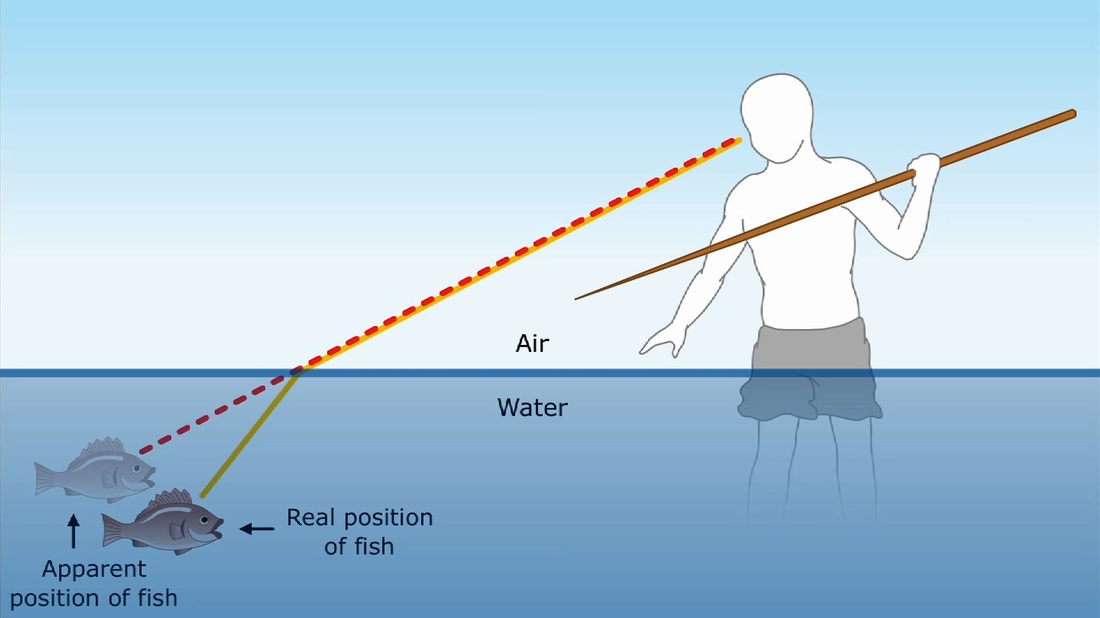
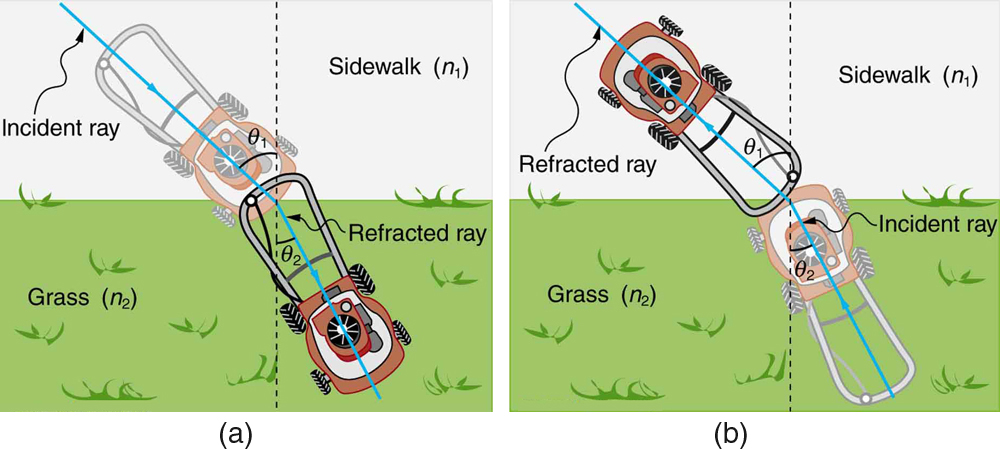
The image above probably works great if you have experience with successful spearfishing. But if not, maybe you’ve mowed a lawn? This diagram does a good job of explaining it too. Maybe this intuition works better for some people.
This relationship is usually called “Snell’s Law”.

However, the fellow was born with the name Willebrord Snel van Royen. Just one “L”, not two. Where did the second “L” come from? I’m glad you asked.
It was fashionable at the time to Latinize one’s name. Latin names sounded cooler. They worked better across countries. Latin was a common denominator. People have been electing to change their names throughout history (e.g., when immigrating to another country) and still do today. For example, people who pick a common English name because their given name is hard for English speakers to pronounce.
Willebrord latinized his last name to Snellius. Then, someone shortened it to Snell. Who did that?
Well, Snel / Snellius died kind of young, at age 46. He didn’t get around to publishing everything he had done. His precise mathematical description of the law that bears his name (in some form), was found and published by Christiaan Huygens, who decided to drop the last two letters from the Latinized form and credit him as “Snell”. That’s why we spell his name that way today.
By the way, Christiaan Huygens also got in on the Latinization craze, and dubbed himself Christianus Hugenius. But is perhaps better known by his non-Latinized name.
And several other people hit upon the same law around the same time in the 1600s: Thomas Harriot, Rene Descartes, and Pierre de Fermat.
But really, it is Ibn Sahl who deserves the credit, to the best of our knowledge. He wrote down the law in the year 984.