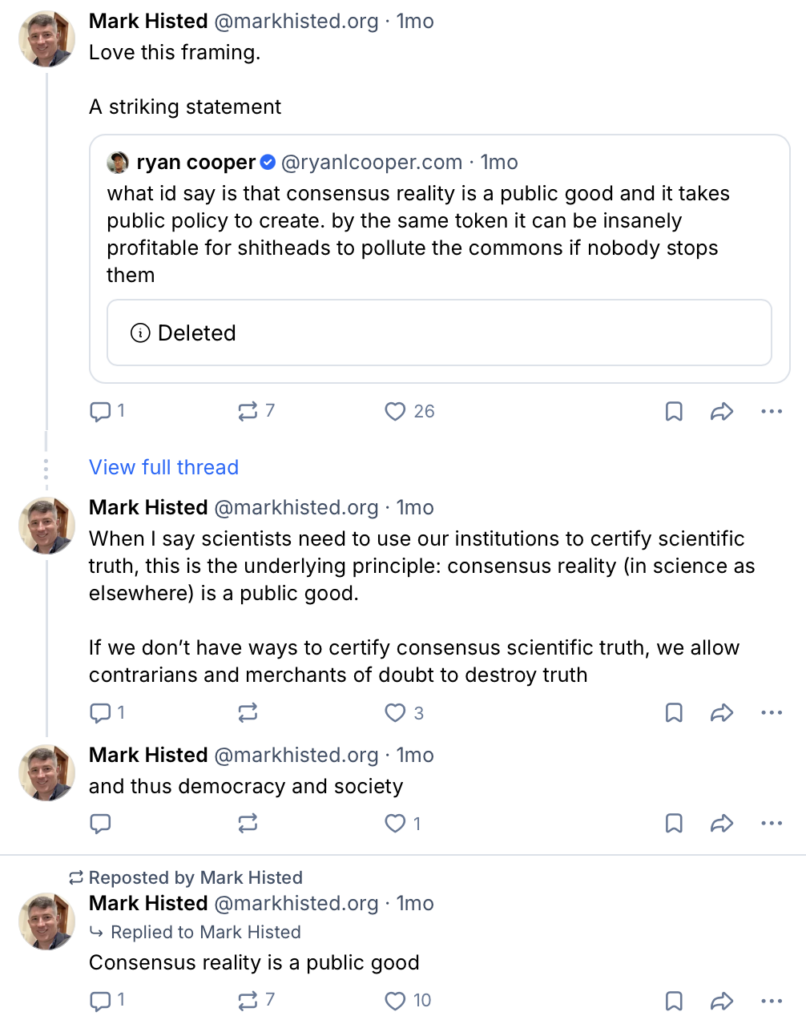
Consensus reality is a public good
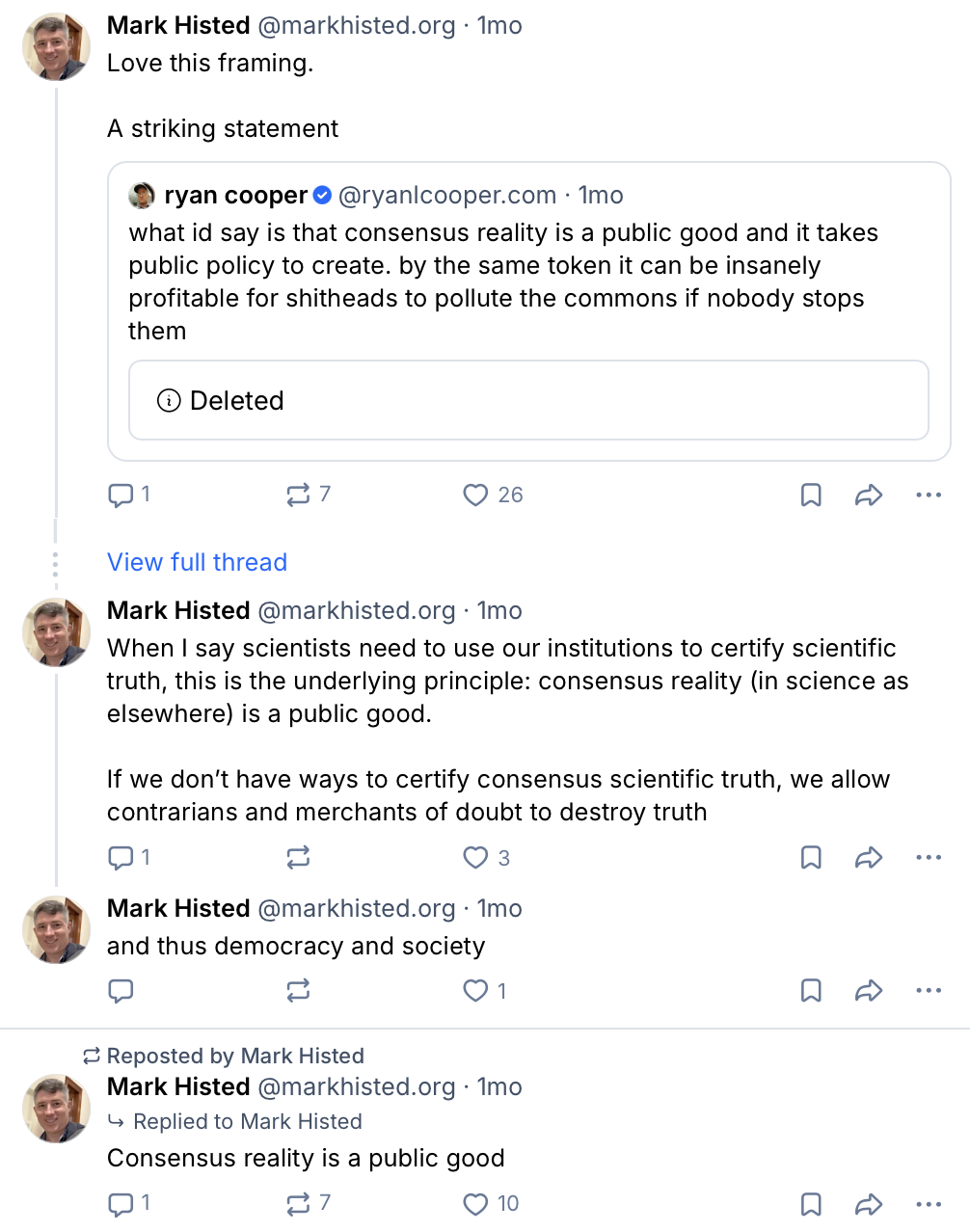
This comment by Ryan Cooper came to me from Mark Histed. It has stuck with me, and Mark has repeated the idea a few times. For years now, I’ve been annoyed at how hard it is to find good news sources. Conventional media can be compromised by multiple sources (gaining/retaining advertisers, billionaire owners), as can publicly supported media (government grants, donors), and social media is a thicket of grifters, echo chambers, and bots. Thus, the news that is easiest to find is often low quality.
But maybe I shouldn’t be so annoyed. Maybe I just needed to learn a bit more about other models out there. Like Mr. Rogers learned from his mother: “Look for the helpers.” Here are some examples. Maybe none of them are perfect, maybe you know better sources (please do share), but it’s wonderful that people are working on this public good. Here are some items:
- The McKnight Foundation has funded efforts in this area. I’m fond of them because they are based not far from where I grew up, and they funded some early work in my own lab. Excellent people. Excellent organization.
- The American Journalism Project is one of the efforts McKnight has helped to fund. They focus on helping local news sources develop.
- The Lenfest Institute is focused on local news too. And they control the Philadelphia Inquirer.
- The Guardian is a non-profit organization, and has been for a long time. Profits go into journalism, not shareholders or owners.
- The Texas Tribune is non-profit too.
- CalMatters is a non-profit near me– a 501(c)(3) for over a decade.
- The AP is a non-profit too, funded by newspapers, mostly.
- Consumer Reports has been non-profit and independent for 90 years.
- There are others as well, and it’s a motley crew, like ProPublica, and also Mother Jones and CSM (both of which are secular, despite their titles).
If you want to consolidate your own news feed, try this: https://findyournews.org
So, the model of non-profit news can work. I admire PBS, NPR, and related organizations as well. They are filled with good people doing good work.
I’m doing this post for two reasons. The first reason is above: highlighting examples of successful non-profit news organizations covering politics and current events in a way that can help cultivate a consensus reality.
The second reason is to simply core dump some ideas of how to do more of this. And do it big. Here goes:
- Completely decouple funding from operations. Start with a big endowment, and only operate on surplus. Generally that’s about 4% of the endowment annually. Accept donations, but 100% of donations have to go to the endowment. This way, the operations are never dependent on donations or any source of new funds. The fiduciary board must release the 4% annually and has zero power to veto specific stories or fire editors. Spending growth only grows as the endowment grows. This alone is a huge piece of the puzzle. But it’s not the whole package. Governance can still be corrupted. So how do we address that? Here are some ideas:
- Distributed governance across multiple classes of stakeholders who nominate and elect leadership: (i) Internal, like staff reporters and editors– they care about the day-to-day operations and professional standards; (ii) Academics, like journalism and history profs– they care about getting it right long-term; (iii) Audience, like a random lottery of long-time subscribers who get to vote for leadership positions– they care about the product and how they can consume it; (iv) Librarians, they care about value, fact-checking, and archiving.
- Regular turnover with ethics guardrails to ensure fresh, constructive leadership. Five-year, non-renewable terms for editors and other leaders. Top personnel cannot join a political campaign or a lobbying firm for three years after leaving, funded by a “severance tail” from the endowment to ensure they aren’t auditioning for their next job while in the editor’s chair.
- Open source reporting processes to ensure that every story includes a public appendix of all raw transcripts, data sets, and conflict-of-interest disclosures for the writer. Sources can remain anonymous, of course, and editors can provide additional confidentiality as warranted.
- Public Ombudsman who is a paid, high-profile, independent critic hired for a non-renewable term whose only job is to publicly eviscerate the organization’s own biases and errors every week.
None of these items are a silver bullet, and even in combination it cannot account for every corrupting influence. But it’s a start. And it’s not a particularly exotic start either– there is precedence for much of this. So whenever a billionaire buys a newspaper or media outlet, if they aren’t doing a lot of this, then their intention should be suspect.
I’ve written before about how a billionaire could do a big donation and instantly manifest a top tier research university. It would actually take less to instantly manifest a top tier news foundation focused on current events and politics to create a public good. Top-tier media organizations like the AP or the Guardian spend about $350-500 million per year. $10 billion would do it. There are hundreds of people in the world with that kind of money. And honestly, even 1/10 of that ($1 billion; thousands of people in the world have that kind of money) would do a lot and the foundation could build from there. That $40 million per year to start would already be more than the Intercept, the Texas Tribune, ProPublica, CalMatters, or many other impactful news organizations spend per year.