A custom two photon scope on a wall
Posted in Hardware
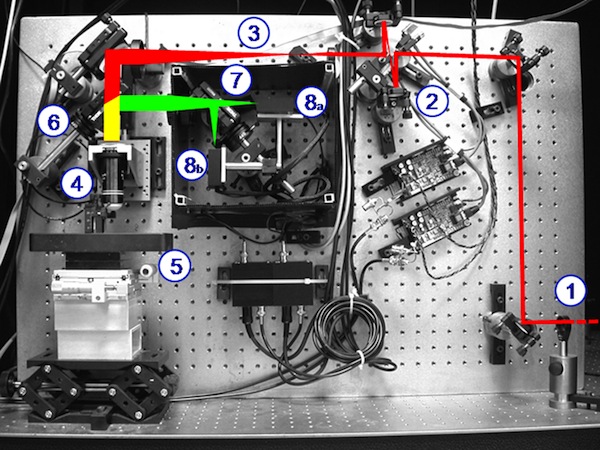
This isn’t an overhead view of the table, they just built the whole thing on a vertically-mounted breadboard. Cool. (link)
This isn’t an overhead view of the table, they just built the whole thing on a vertically-mounted breadboard. Cool. (link)
Copyright © 2010-2026 Labrigger
I’m surprised that this is not a much more commonplace practice in the space conscious labs in Europe. I’ve seen the two-tier setups with some launch optics on a second-level pillar-mounted breadboard more often, but it seems as if the vertical option might make components easier to reach for adjustment?
I hope you don’t mind me mentioning, but Micro Control Instruments now supply good value breadboards to European labs. Check out http://www.mci-neuroscience.com/product/optical-breadboards/
http://labrigger.com/blog/2012/02/29/tsiens-voltagefluors/
Does anyone know of a recent publication reviewing the latest developments of VF and other voltage sensitive dyes? And do current sCMOS cameras have the required characteristics to reliably record fast (1ms) events in neurons?
I’m surprised that this is not a much more commonplace practice in the space conscious labs in Europe. I’ve seen the two-tier setups with some launch optics on a second-level pillar-mounted breadboard more often, but it seems as if the vertical option might make components easier to reach for adjustment?
I hope you don’t mind me mentioning, but Micro Control Instruments now supply good value breadboards to European labs. Check out http://www.mci-neuroscience.com/product/optical-breadboards/