Posts tagged with funding

You probably already know that many grants have, in addition to the direct component that goes to the lab, an indirect component that goes to the institution.

US institutions negotiate with the NIH to set a percentage for all awards. For example, here are Harvard’s (relatively high) indirect rates. These indirect funds are used by departments and institutions to keep the lights on, pay admin staff, cover startups, and other important things.

A recent Nature article by Paula Stephan offers this insight into one aspect of how indirect rates are set:
“A US government accounting rule called A21 means that the more debt universities have from construction, the more they can add to grants for overhead costs. If a university borrows $100 million to build a new facility and pays 4% interest, it can increase its indirect rate by including the $4-million interest payment in the calculation. ”

The article concludes with, “Perhaps it is time for deans in the biomedical sciences to rent some of that excess space to their colleagues in chemistry and physics.”

Has biomedical research grown too big? Does it need to contract? Or is it only PhD programs that need to contract? On that topic, the article also suggests making graduate students more expensive to academic labs, and staffing labs with more professional scientists.

There are some open access journals that seem to have relativley loose editorial standards. And by “editorial” I mean “ethical”, and by “relatively loose”, I mean “no”. These publishers have been called “predatory” open access publishers. The idea is simple: solicit submissions via spam email, accept submissions, and then charge publication fees that more than cover the cost of your spamming operation. Here’s a list of predatory open access publishers. Richard Poynder did a very in depth story on this phenomenon. If you’re interested to know more, read the PDF linked to on this blog post. The bottom line is, it works. At least some people send papers to predatory open access journals and pay to have them published. And that’s why any email address you’ve used as a corresponding author will get inundated with spam from these outfits.

What’s new– to me at least– is what seems to be predatory micro funding for scientific research. Microfinance has been used for many years to get enterprises off the ground. More recently, groups like Kickstarter have developed web sites to finance proposed creative and technology projects. Kickstarter is cool. It’s all above the table, as far as I can tell, and has many success stories.

By contrast, the Open Source Science Project is sketchy as hell. Here’s the model: researchers post project proposals and funders browse and decide what they want to fund. This is very similar to Kickstarter. However, the business makes money by charging the researchers monthly subscription fees. At this point, I’m gone. That’s the only red flag I need. But there are other red flags too: zero success stories, endless attempts to look legit by association (a bunch of university and industry logos all over their site), the “Privacy Policy” and “Terms of Use” do not actually link to anything, and the identity of the people running the organization is not revealed anywhere. There is no evidence that anyone has ever had a project funded through their system.

Think you could do a better job allocating the NIH budget? This is your chance to not just armchair quarterback the budget management, but offer some constructive input.

Sally Rockey is actively soliciting your comments and it’s not too late to chime in.

First, try the nifty web app they built where you can adjust the number of small and large grants funded and see how that changes the landscape accordingly (screenshot above).

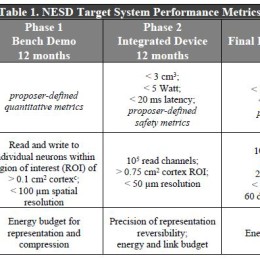
There’s an RFI (request for information) out now for the NIH Blueprint for Neuroscience (the structure that cuts across different institutes that all support neuroscience: NINDS, NIMH, NEI, etc.). These RFIs are an opportunity to tell the NIH what you think they should spend money on. Specifically, they’d like to know about:

  • Identify areas of neuroscience research that could be accelerated by the development of specific research resources or tools.
  • What are the major opportunities for, and impediments to, advancing neuroscience research?
  • What are the 2-3 highest priority tools or resources needed to capitalize on the scientific opportunities and overcome obstacles to progress in neuroscience research?
  • Describe how NIH Blueprint might best facilitate the development of these tools/resources.
  • It’s not much money this year, but there are other activities ending in a few years so they anticipate more money being available and want to have their priorities thought out when that happens.

    If you haven’t responded to an RFI before, it’s very simple. Just send an email to nihblueprint@nih.gov by Sept 9, 2011. All of the responses are anonymized and compiled for review.

    The subject of prolificacy came up in lab the other day. A study from the 80s (pdf) plotted the number of papers from a lab versus the number of people in the lab. This was repeated for several large research institutions. Across all of the data, the average was 1 paper/person/lab.

    A graph from that paper is shown above. They included brief reports and unrefereed contributions to books, but did not include abstracts. Note that the spread is quite large. Among the labs with 20-30 people, output ranges from 10 to 60+ papers/year. Similarly, for labs with 10 or fewer people, output ranges from 0 to 28 papers/year. Perhaps part of the variability can be accounted for by variations from one discipline to another. Laboratories in the National Cancer Institute can include biochemistry, physiology, and cell biology.

    How about # of publications vs. lab funding?
    According to analysis by Jeremy Berg of NIGMS, it basically plateaus, or there is no relationship, depending on how you measure. (link, follow up)

    Or death rate versus NIH funding?
    Given a 10 year lag, actually pretty correlated. (source)

    (hat tip to AM)

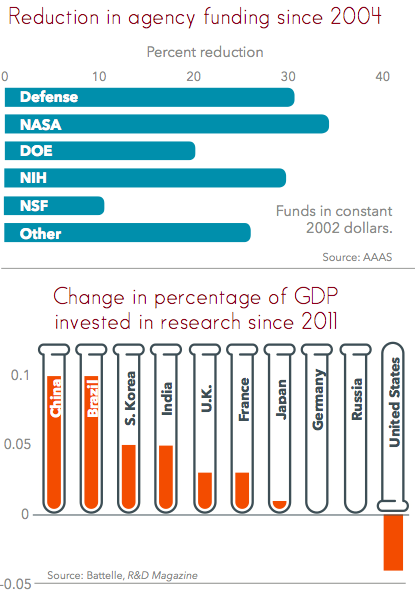
    Funding is tight all over. The question is only: How tight? The White House released its budget today. It’s just a proposal, and is subject to massive revision by Congress, but it may indicate where the priorities are. The NIH is slated to get a 3.4% increase from the actual 2010 level. If that holds, even just a little bit, it’s not as bad as it could have been. By the way, the NSF has been doing a little better than the NIH recently, and the White House has proposed a 13% increase for 2012. If you’ve got an idea they might be interested in, you may want to consider one of those grants.

    NIH grants are scored on five dimensions:
    1. Significance
    2. Investigator
    3. Innovation
    4. Approach
    5. Environment
    (link)

    What are the correlations between these different dimensions and ultimate grant funding success?
    Here’s a table of all the NIH institutions, and the correlation coefficients for these scoring dimensions and ultimate funding success.

    Take home message = nail the approach.

    (source)(via)

    Nature Neuroscience has a great article on citizen science in the September issue (link, subscription required).

    In the article, they discuss that although the public already recognizes the value of publicly funded research, the priority they place on it could be raised if they feel more involved. One way they can get involved is through microfinancing, where relatively small amounts of money can generate a tangible result for the donors on a short time scale.

    Such microfinance efforts will not make an immediate dent in systemic problems of insufficient funding, but increased personal investment in scientific research could help improve scientific literacy and enthusiasm for science and, ultimately, win stronger backing for federal support of scientific research.

    They also discuss the additional benefits of getting scientists to engage the public directly. I’d like to add one thought to that. Carrying out experiments in an entirely open and public process is a potentially very fruitful alternative to the more typical MO of a high level of discretion and, at times, outright secrecy.


    Here are the microfinance sites they discuss:
    FundScience
    SciFlies
    Eureka Fund
    Open Source Science