Posts tagged with machining

3 comments

Sense of scale

The vast majority of the time, I buy what I intend to. Like the old maxim from construction: “Measure twice, cut once”, I always take care to ensure I’m ordering the right thing. At least when things are expensive. When they’re cheap, I’m less careful. Check out the photo above. I thought, “Sure, that’s the bench vice I’m looking for.” It was so inexpensive, that I went ahead and ordered it without much thought.

I don’t know how big that vice looks to you, but I was surprised when it arrived. Click through to get the sense of scale…
Read the rest of this entry »

When I’m in a tight spot and don’t have CAD software handy, there are a couple of sites I use to view CAD files online.

ShareCAD lets you upload CAD files in a lot of different formats and displays the 3D model. It offers very minimal interaction, but you can pan and zoom. You also get a link that you can share via email with collaborators so that they can view and download the file. Handy.

ProfiCAD’s AutoCAD Viewer is more limited, but sometimes works where ShareCAD doesn’t. For example, here is an AutoCAD drawing that ShareCAD couldn’t handle.

0 comments

Raw materials

If you need a chunk of metal for a custom piece for your rig, what are the options? The best way to go is to buy a part that is close to what you need and then modify it, probably some sort of optomechanics. Alternatively, you can buy a chunk of metal and machine it from scratch yourself. McMaster-Carr is a classic place to get raw materials in US, and Fastenal has a smaller, but similar product line. Online Metals, Speedy Metals, and Metal Express are other places to check. RS is the first place I check in the UK (they’re listed under “Workshop Consumables”, and then “Engineering Materials”). Most of the time, the piece you can buy is woefully oversized for what you need. If you don’t have all the tools in your shop to do the rough shaping (cold saw, band saw, horizontal band saw, etc.), then ask a local workshop to do it for you. This sort of rough work should be dirt cheap with fast turnaround, and it saves you having to buy a whole new tool for your own workshop.


I use SolidWorks to design custom parts for my rigs. Many times, these parts mate with existing Thorlabs parts. Fortunately, Thorlabs offers SolidWorks files that can be directly added to an assembly to ensure everything fits. It’s easy to fix relationships between parts (e.g., force a part to slide along posts in the cage system), and determine how everything fits together.

In the screenshot above, some of you probably recognize the Thorlabs cubes, like Darcy was talking about recently, which are so handy. Here, I use one as a enclosure for a dichroic flipper (custom designed in SolidWorks, then 3D printed), and another in the collection pathway.

Thorlabs recently broke ground on a new corporate headquarters in New Jersey. They’re clearly doing a lot of things right. I like their easy-to-navigate website, fast shipping, and how they share a lot of technical information on their parts (including the SolidWorks files of the parts as mentioned in this post).

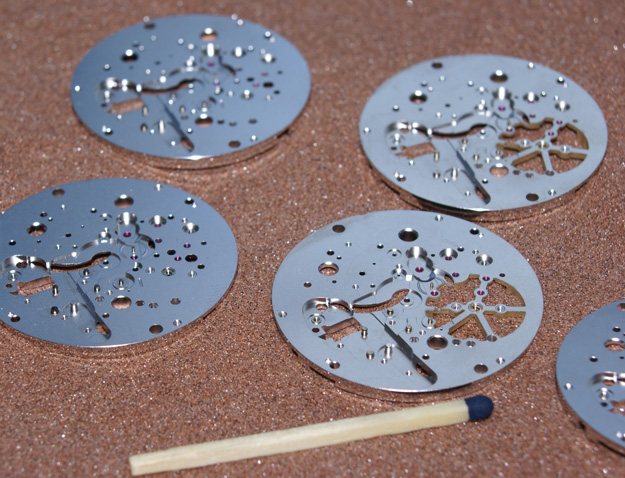
Micro Waterjet has an abrasive-based technique that enables laser-like precision for machinging small parts. The benefits are: no heat damage/distortion, and materials that are toxic when burned can be machined to laser precision. The jet itself is about 0.35mm in diameter, and this helps them achieve cutting precision of 0.01mm and positioning precision of +/-0.003mm.

Most institutions have their own workshops that will machine parts for researchers, but these workshops are of varying quality and capacity. Often researches will become frustrated by their local workshop estimating delivery times on geological time scales. This can inspire the fantasy of owning your own CNC mill. But do you really want one? And if so, which one?
Read the rest of this entry »