Posts tagged with microscopy

clarity

Post by Jeffrey Stirman

The opacity of the brain is one barrier to optically imaging individual neurons and their connections. Scattering in tissue is the main reason tissue is not transparent; absorption also plays a role but much less so. Perfusing tissue with a substance to match the index of refraction throughout the preparation (and thus decrease scattering) is one approach, and although index matching isn’t a new strategy, just getting rid of the membranes is. The most recent method to achieving tissue transparency (Chung et al., 2013), takes this approach to great effect.

A nice paper discussing tissue transparency is Johnsen and Widder, 1999. Scattering in tissue is dominated by Mie scattering which is the scattering of light by particles of a size on the same order as the wavelength of light (Rayleigh scattering is for particles much smaller than the wavelength): cells, nuclei, and organelles all fit in this category. Furthermore, the lipid membranes encasing these structures have a significantly different refractive index (~1.5) than the surrounding medium. It is this change in refractive index of these particles that lead to scattering. Simply, as the difference in refractive index between the surrounding medium and the object increases, so too does the scattering. The relationship with wavelength can be complicated and range from about lambda^-4 to lambda^0.2 (lambda = the wavelength of light used) depending on the size of the particle, but overall the higher the wavelength, the less scattering (one of the benefits of 2-photon imaging).

table

A couple of nice papers from Mourant et al. (1998 & 2000) discuss and explore in more detail the dominant scattering centers in tissue. They found that at small angles, most of the scattering was dominated by the nucleus and at larger angles the smaller structures such as mitochondria. One conclusion from all this is perhaps it might not be sufficient to homogenize the refractive index of the tissue if those lipid membranes still exist (as earlier attempts had done). In fact, the best way to achieve tissue clarity for imaging is to remove the objects that cause the scattering. This is exactly what Kwanghun Chung did! By first crosslinking most of the proteins, DNA, and other biological entities (not the lipids), then cross-linking them all in a hydrogel structure, he was able to use a detergent extraction process (electric field assisted) to remove the lipid membranes and thereby removing the cause of most of the scattering centers. Since multiple rounds of antibody staining can be performed on the cleared tissue, this process seems to have achieved clarity while preserving most of the interesting biology.

tpp

s1

More open source software to check out.

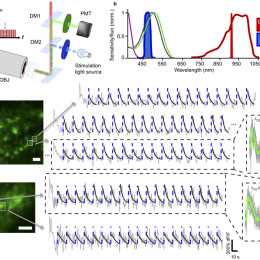
Two-Photon Processor and SeNeCA – A freely available software package to process data from two-photon calcium imaging at speeds down to several ms per frame.
Jakub Tomek, Ondrej Novak, and Josef Syka
TJ Neurophysiol published 10 April 2013, 10.1152/jn.00087.2013

It’s notable in that it is an “all-in-one” package that’s freely available.

The image processing to detect cells and draw ROIs seems to work pretty good, even with poor S:N. I’d like to see it operate on GCaMP images, since those are more challenging in some ways. Cells labeled with Oregon Green BAPTA-1 tend to exhibit spherical patterns of somatic fluorescence, but GCaMP, when it’s working well, does not brightly label the nucleus, so the shape of the ideal ROI is quite different. Plus, it’s nice to pick up dendrites and other features, not just somata.

See also, Vogelstein’s code for inferring action potentials in calcium imaging data.

s2

Hat tip to Christian Wilms
EDIT: The code became available shortly after this post.

HelioScan is a LabVIEW-based software suite from Fritjof Helmchen’s group that is specialized for running 2 photon microscopes, and is carefully designed to be modular. This modularity is intended to make it more easily adapted for different rigs and experiments, and robust to the frequent version forking that happens in lab environments.

It’s all open source and has online user and developer documentation, which should help guide developers.

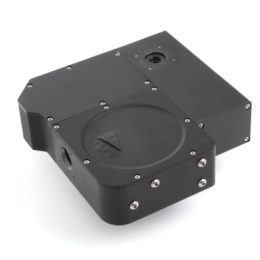
With its newly introduced scan head, Scientifica’s 2p scope is finally a complete package. They’re happy to sell their modular design in pieces, so this fills the void between fully custom rigs and turnkey systems.

The scan head uses a relay lens system (a.k.a., a 1:1 telescope) between the x- and y- galvo mirrors. Most scopes opt to simply put the x- and y- galvo mirrors as close to each other as possible. The inclusion of a relay system is an interesting choice. Although not unheard of in 2p scopes or laser scanning scopes in general, I suspect they might become very popular for some fields of research. Here’s why…

Read the rest of this entry »

This paper (York et al. 2012) came out earlier this year, but I thought it’s worth highlighting here, give the subject matter.

We present a hybrid technique, multifocal SIM (MSIM), that combines the resolution-doubling characteristics of SIM with the physical optical sectioning of confocal microscopy. MSIM uses sparse 2D excitation patterns generated with a DMD integrated into a conventional wide-field microscope and digital processing after acquisition (‘postprocessing’) to obtain optically sectioned images with ~145-nm lateral and ~400-nm axial resolution at 1-Hz frame rates. Relative to existing SIM, our implementation is easier to integrate onto existing microscopes and is considerably cheaper than commercial SIM.

For imaging, they used an sCMOS camera: the pco.edge (I’ve demo’d one, they’re very cool). In the supplement, they offer some helpful tips on how to set up the camera to obtain high quality images. This section is a good example of how the authors carefully prepared the paper to ensure that others can replicate their success– all methods papers should be this detailed and helpful.

The lead author, York, recently commented in the confocal listserv and shared some of his thoughts and code on the pco.edge camera (link).

0 comments

Micro-Manager

Micro-Manager (µ-Manager) is an open, ImageJ-based suite of code for controlling microscopes and associated instrumentation. Check out the list of supported equipment.

Drosophila embryos are a fraction of a square mm, and go from fertilization to hatching (as a larva) in about 22 hrs. So it’s possible to image individual embryos in their entirety with minute or sub-minute level temporal resolution (each 3D snapshot takes about 30-500 seconds, depending on method and resolution).

A couple of papers exploring whole embryo imaging appear in the latest Nature Methods. The accompanying N&V does a nice job of summarizing the different approaches. Check out some of the movies. They’re spectacular.

0 comments

Microbehunter

Oliver Kim puts out a nice magazine called Microbehunter. It’s a great resource for microscope nerds. I’ve listed a few blog articles below, but actually, the full PDF issues are where most of the meat is. Lots of in depth, well-written articles on the history of microscope technology, and, of course, microbes. Highly recommended.

Connecting a camera to a microscope (very thorough)
Cover glass thickness and resolution
Setting up a home lab for microscopy

To recap the previous post on axial resolution and numerical aperture in two-photon microscopy:

For excitation deep in scattering tissue, higher NA can actually be detrimental because the light cone at the periphery has to travel a longer distance through the scattering tissue compared to moderate NAs. In addition, spherical aberration is more of a problem at higher NAs.

To increase axial resolution, first ensure that you’re overfilling the back aperture of the objective before trying a higher NA objective. A 0.8 NA objective’s axial resolution is only about 50% broader than a 1.0 NA objective. By contrast, underfilling the back aperture significantly makes the axial resolution broader by 200% or more. So before buying a higher NA objective, ensure that you’re actually using all of the NA in your current objective.

For collection, high NA is good, but so is low magnification. For example, a 16x 0.8NA will collect more scattered fluorescence signal than a 63x 1.0NA. A rough image brightness factor can be computed to compare among objectives: average transmittance of visible light * (NA^2/mag)^2

The figure at the top of this post summarizes the brightness factor for a range of different NAs and magnifications*. Several objectives are noted on it as well. At the bottom is the relationship between NA and axial resolution (theoretical best, ref).

Optimal: So what has been recommended for years is to use a high NA objective and underfill it a bit.

In two-photon population calcium imaging, the neuropil response can contaminate neuron responses. This happens when the axial resolution is poor, such that the excitation volume extends out of the soma. This often occurs when the back aperture of the objective is underfilled, resulting in a lower effective NA.

Here’s the relationship between numerical aperture and neuropil contamination.

The influence of neuropil contamination is partially dependent on the signal-to-noise (S:N) of the somatic spike-associated calcium transients. If S:N is high, then a small amount of neuropil contamination can be negligible.

More info:
Part I of axial resolution and numerical aperture
High NA, low mag objectives

* I’ve omitted the transmission characteristic in these calculations. Although IR transmittance varies considerably among manufacturers, in the visible range transmission is consistently around 85% for water dipping, low mag, high NA objectives. Thus the relative measures are unaltered.

Recently, microscope manufacturers have been releasing ever higher NA objectives for multiphoton imaging. Although higher NA objectives should give better axial resolution, they might not be ideal for imaging deep into the brain compared to more moderate NAs.

I think the perception that higher NAs always improve images arises when people try out new, high NA objectives that have smaller back apertures than their old objectives (e.g., an Olympus 20x/0.95 NA or a Nikon 16x/0.8 NA). If the back aperature on the 25x, 1.0+ NA objective they’re trying is smaller, then suddenly they’re overfilling more than before and their axial resolution and S:N are improved. They chalk it up to the NA and swear never to go back to 0.8 NA objectives. However, their old objective might actually be better, and what they really need to work on is their scanning optics.

The key issue is this: high NA objectives bring a large portion of their light in at a high angle. This high angle results in longer paths for the excitation light to take, and this results in more scattering events. The end result is that excitation intensity decreases. This has been shown theoretically and empirically. So if you’ll be imaging deep, consider moderate NA objectives.

By contrast, underfilling the back aperture is a great way to destroy one’s axial resolution. Since the lateral resolution is relatively unaffected, this problem often goes unnoticed (see figure below, its link, and this review). If the excitation beam is less than half of the diameter of the back aperture of a 20x/0.95 NA, then the axial FWHM could be 3x what it should be, or roughly the equivilant of a 0.60 NA objective (theoretical FWHM 5.6 microns), or worse.

Even many commercially available scopes fail to overfill the large back apertures of today’s low magnification/high NA objectives. The major microscope manufacturers need their objectives to fit onto their existing microscope bodies and systems, and this is a major engineering constraint in their design for new imaging systems.