Posts tagged with fluorescence

clarity

Post by Jeffrey Stirman

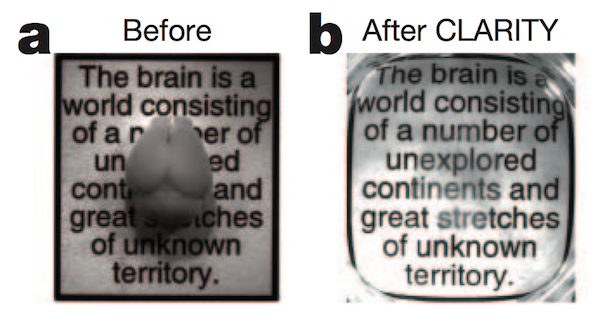
The opacity of the brain is one barrier to optically imaging individual neurons and their connections. Scattering in tissue is the main reason tissue is not transparent; absorption also plays a role but much less so. Perfusing tissue with a substance to match the index of refraction throughout the preparation (and thus decrease scattering) is one approach, and although index matching isn’t a new strategy, just getting rid of the membranes is. The most recent method to achieving tissue transparency (Chung et al., 2013), takes this approach to great effect.

A nice paper discussing tissue transparency is Johnsen and Widder, 1999. Scattering in tissue is dominated by Mie scattering which is the scattering of light by particles of a size on the same order as the wavelength of light (Rayleigh scattering is for particles much smaller than the wavelength): cells, nuclei, and organelles all fit in this category. Furthermore, the lipid membranes encasing these structures have a significantly different refractive index (~1.5) than the surrounding medium. It is this change in refractive index of these particles that lead to scattering. Simply, as the difference in refractive index between the surrounding medium and the object increases, so too does the scattering. The relationship with wavelength can be complicated and range from about lambda^-4 to lambda^0.2 (lambda = the wavelength of light used) depending on the size of the particle, but overall the higher the wavelength, the less scattering (one of the benefits of 2-photon imaging).

table

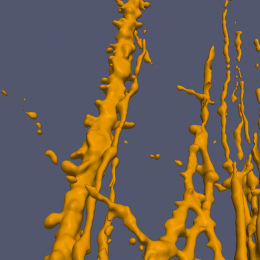
A couple of nice papers from Mourant et al. (1998 & 2000) discuss and explore in more detail the dominant scattering centers in tissue. They found that at small angles, most of the scattering was dominated by the nucleus and at larger angles the smaller structures such as mitochondria. One conclusion from all this is perhaps it might not be sufficient to homogenize the refractive index of the tissue if those lipid membranes still exist (as earlier attempts had done). In fact, the best way to achieve tissue clarity for imaging is to remove the objects that cause the scattering. This is exactly what Kwanghun Chung did! By first crosslinking most of the proteins, DNA, and other biological entities (not the lipids), then cross-linking them all in a hydrogel structure, he was able to use a detergent extraction process (electric field assisted) to remove the lipid membranes and thereby removing the cause of most of the scattering centers. Since multiple rounds of antibody staining can be performed on the cleared tissue, this process seems to have achieved clarity while preserving most of the interesting biology.

dextrans in gel

Post by Christian Wilms

I’ll admit it: I’m lazy. When I use a calcium indicator and need to know its physico-chemical properties, I like to simply look it up in the manufacturer’s catalogue or website. Of course I don’t expect those values to be perfect, but close enough for most purposes. Turns out that isn’t the way things are.

While looking into using a dextran conjugate of OGB-1 some time ago I stumbled over the first problem: depending on where on the Invitrogen website one looks, you find two different K_d values: 165 nM and 265 nM. Different, but still both clearly “high affinity”. Things got a little more complicated when I received the indicator and discovered that the K_d specified on the vial was 1180 nM — not really high affinity. Running a calibration experiment revealed more: instead of a single K_d, the indicator appeared to have 2, one medium affinity around 300 nM and one low affinity at well over 1000 nM. Another thing I noticed was the dynamic range of the indicator was reduced from 14-fold for the free salt form to just above 5-fold for the dextran conjugate, which also wasn’t specified in the documentation. I have since then found that these values differ from batch to batch. All of this applies to dextran conjugates of other indicators as well.

Similarly, “anionic” fluorescent dextran conjugates aren’t always negatively charged. Running a selection of three different Alexa-Fluor conjugates on an electrophoresis gel reveals that they are all mixtures (which is not surprising) and in some cases the cationic forms dominate (which *is* surprising; e.g. Alexa-546 in picture).

More worrying, as it applies to the free salt form of a calcium indicator, was an observation mentioned in a recent publication by Faas and Mody:

“We have to make an extremely important note of caution here: over the past 8 years, we have determined the properties of each individual factory batch of OGB-5N we used, and found that their properties vary considerably (see Table 1). Although the properties within a batch are very stable, we found that between batches the Kd varied from 34 to 46 ?M and the Fratio (Fmax/Fmin) varied from 10 to 40.”

(Faas & Mody; BBA-General Subjects, 1820(80): 1195–1204)

While the variability in itself is unpleasant, what I find to be really problematic is that these things appears to be ignored by suppliers and researchers need to work them out for themselves. At the very least one would expect catalogues to specify ranges for both K_ds and gain factors. Ideally, the correct values for the current batch should also be specified. Until then: if it’s even mildly important, don’t trust the specs.

1 comments

Photoswitchable GECI

Many red fluorescent proteins go through a green fluorescent stage prior to becoming fully folded into their mature red fluorescent state. In fact, some proteins can be photoswitched in and/or out of their mature red state, e.g., Dendra2, EosFP, and Kaede.

Given this protein engineering know-how, perhaps it was just a matter of time before someone made a photoswitchable genetically encoded calcium indicator (GECI). The excellent OpenOptogenetics blog has a post up on the recent report from Robert Campbell and Takeharu Nagai labs (two GECI heavyweights). (link to article)

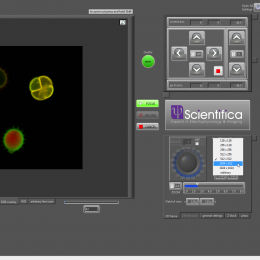
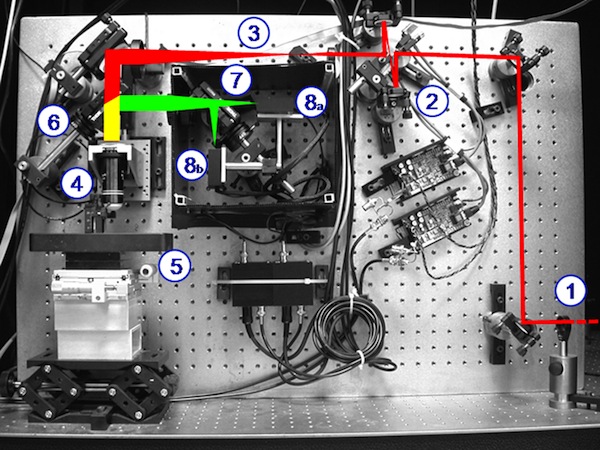
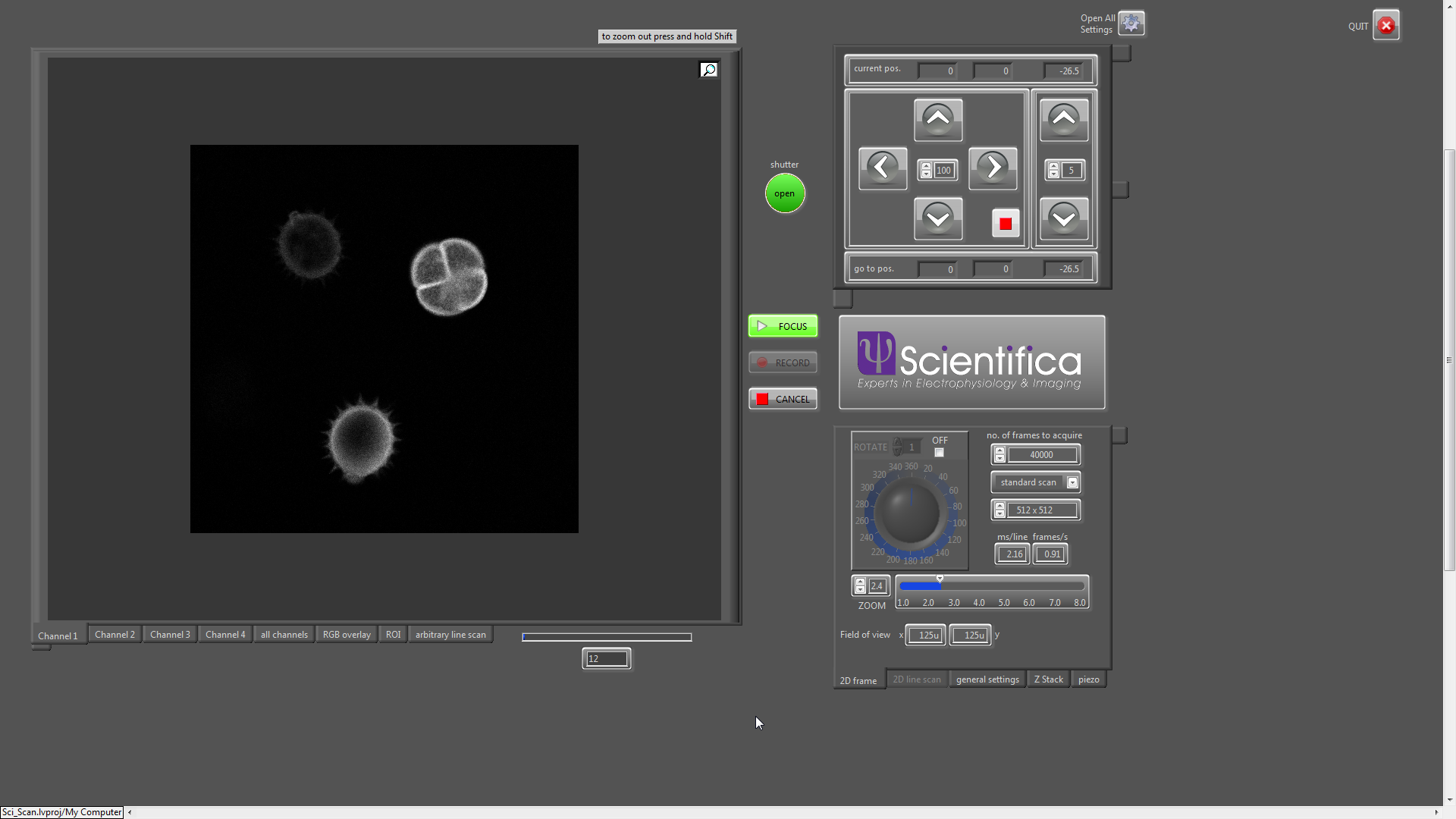
Last Monday, Labrigger covered HelioScan, a LabVIEW-based, two-photon laser scanning microscopy software suite.

Marcel van ‘t Hoff (left) and Dominik Langer (right) are the two main developers of HelioScan. They were kind enough to answer some interview questions for Labrigger.

LR: Are there special considerations you had to make when designing HelioScan? What measures did you take in LabVIEW to support the level of modularity?
The main design considerations were to design for future flexibility and for multiple developers to easily collaborate without interfering. The idea was then to assemble the software at run-time from components that are dynamically loaded based on configuration settings. LabVIEW classes are the ideal candidates for such components:

First, they naturally bundle data and corresponding VIs into separate entities.

Second, LabVIEW allows to load and instance classes at run-time based on the class file path (which can be specified in a configuration file).

Third, using class inheritance and polymorphy, we can substitute any two components, as long as interacting other classes refer to them in terms of the same abstract base class. For example, a particular ScanHead component can handle any incoming Trajectory component as long it is a subclass of a particular expected abstract base class.

Fourth, by means of aggregation combined with the above principles, we can build up highly complex objects at run time.
An example: HelioScan may read from its main configuration file to load a particular ImagingMode. During its initialization, the loaded ImagingMode object reads its own configuration file, stating that – among other components – a particular ScanHead component is to be loaded. Once loaded, the ScanHead object reads a configuration guiding it to load a bunch of Scanner components of a particular type, etc.

A couple of others have implemented individual components, demonstrating that the distributed multideveloper scenario is working.

LR: In the near future, say 5 years, who will be maintaining the core HelioScan codebase and leading new developments?
We are currently in a transition phase. First, both Marcel and I just left Fritjof Helmchen’s lab. While Marcel is going to continue as a postdoc in the field and will still use HelioScan, I will leave the academic field. Second, we are currently working on a major new version of HelioScan that we expect to bring about another quantum leap in flexibility. The new version will be based on a framework for distributed cross-platform signal processing (Murmex) that we are developing. We have been developing this framework in our free time and plan to continue doing so. Murmex as the new core will allow HelioScan components to be written not only in LabVIEW, but various other well-known programming languages. We believe that this will lower the entry barrier for new developers enough for HelioScan to become a project that can be handed over to the community. New components will be collected on a central repository, given that they meet some basic quality standards. This will be similar to certain ImageJ distributions, such as FIJI.

LR: Do you have design principles that you follow to ensure that your LabVIEW programs don’t become spaghetti?
First, we try to stick as far as possible the style rules from “The LabVIEW Style Book” (Peter A. Blume, Prentice Hall) [Also covered here. -Labrigger]. That’s also the book we usually recommend to newcomers before they start to develop their own components.

Second, HelioScan is implemented using LabVIEW object-oriented programming (LVOOP), which naturally already structures the code by bundling related data and functionality into LabVIEW classes.

Third, we made very good experiences with the so-called XControls of LabVIEW. XControls are your own, re-usable user interface controls, which can provide arbitrarily complex functionality. For example, we made an XControl that allows to load and display multi-page TIFF files, where the user can scroll through the frames, draw different types of ROIs, load and save ROI seletions, and display file meta-information. On the VI block diagram, this whole functionality is represented by a single terminal, hiding all the underlying complexity from the developer.

Fourth, we heavily use a couple of design patterns to do certain things.

Fifth, the HelioScan framework enforces a lot of structure. When we develop a new component, we subclass an abstract class of the framework and override some of its methods. For example, when we need a new scan pattern for galvanometric mirrors, we subclass a generic Trajectory class. We override (among others) the initialise method of the class and put the code initialising the pattern exactly there (and nowhere else).

Read the rest of this entry »

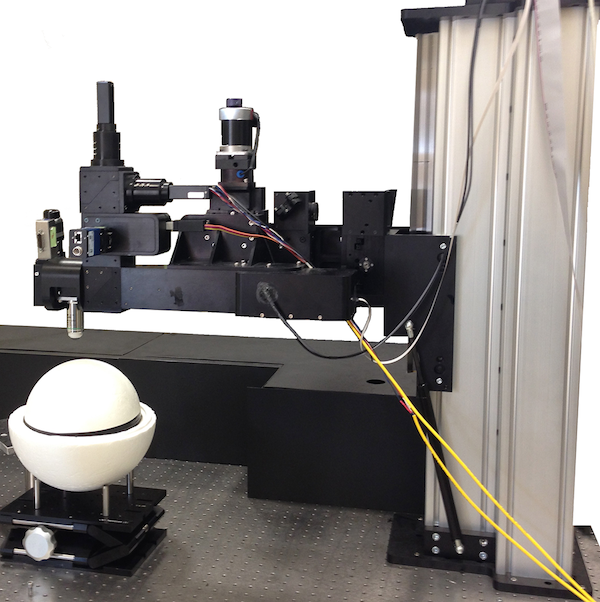
Enrico Stefani’s lab at UCLA has a couple of crack engineers on board, Yong Wu and Pedro Felipe Gardeazábal Rodríguez. These two fellows built a custom STED system and have documented the setup on their website.

And, for excellent Labrigger community members like htwe, they include comparisons to confocal imaging, rather than widefield imaging.

Please check out their site for more information.

Hat tip to Christian Wilms.

Drosophila embryos are a fraction of a square mm, and go from fertilization to hatching (as a larva) in about 22 hrs. So it’s possible to image individual embryos in their entirety with minute or sub-minute level temporal resolution (each 3D snapshot takes about 30-500 seconds, depending on method and resolution).

A couple of papers exploring whole embryo imaging appear in the latest Nature Methods. The accompanying N&V does a nice job of summarizing the different approaches. Check out some of the movies. They’re spectacular.

To recap the previous post on axial resolution and numerical aperture in two-photon microscopy:

For excitation deep in scattering tissue, higher NA can actually be detrimental because the light cone at the periphery has to travel a longer distance through the scattering tissue compared to moderate NAs. In addition, spherical aberration is more of a problem at higher NAs.

To increase axial resolution, first ensure that you’re overfilling the back aperture of the objective before trying a higher NA objective. A 0.8 NA objective’s axial resolution is only about 50% broader than a 1.0 NA objective. By contrast, underfilling the back aperture significantly makes the axial resolution broader by 200% or more. So before buying a higher NA objective, ensure that you’re actually using all of the NA in your current objective.

For collection, high NA is good, but so is low magnification. For example, a 16x 0.8NA will collect more scattered fluorescence signal than a 63x 1.0NA. A rough image brightness factor can be computed to compare among objectives: average transmittance of visible light * (NA^2/mag)^2

The figure at the top of this post summarizes the brightness factor for a range of different NAs and magnifications*. Several objectives are noted on it as well. At the bottom is the relationship between NA and axial resolution (theoretical best, ref).

Optimal: So what has been recommended for years is to use a high NA objective and underfill it a bit.

In two-photon population calcium imaging, the neuropil response can contaminate neuron responses. This happens when the axial resolution is poor, such that the excitation volume extends out of the soma. This often occurs when the back aperture of the objective is underfilled, resulting in a lower effective NA.

Here’s the relationship between numerical aperture and neuropil contamination.

The influence of neuropil contamination is partially dependent on the signal-to-noise (S:N) of the somatic spike-associated calcium transients. If S:N is high, then a small amount of neuropil contamination can be negligible.

More info:
Part I of axial resolution and numerical aperture
High NA, low mag objectives

* I’ve omitted the transmission characteristic in these calculations. Although IR transmittance varies considerably among manufacturers, in the visible range transmission is consistently around 85% for water dipping, low mag, high NA objectives. Thus the relative measures are unaltered.

Recently, microscope manufacturers have been releasing ever higher NA objectives for multiphoton imaging. Although higher NA objectives should give better axial resolution, they might not be ideal for imaging deep into the brain compared to more moderate NAs.

I think the perception that higher NAs always improve images arises when people try out new, high NA objectives that have smaller back apertures than their old objectives (e.g., an Olympus 20x/0.95 NA or a Nikon 16x/0.8 NA). If the back aperature on the 25x, 1.0+ NA objective they’re trying is smaller, then suddenly they’re overfilling more than before and their axial resolution and S:N are improved. They chalk it up to the NA and swear never to go back to 0.8 NA objectives. However, their old objective might actually be better, and what they really need to work on is their scanning optics.

The key issue is this: high NA objectives bring a large portion of their light in at a high angle. This high angle results in longer paths for the excitation light to take, and this results in more scattering events. The end result is that excitation intensity decreases. This has been shown theoretically and empirically. So if you’ll be imaging deep, consider moderate NA objectives.

By contrast, underfilling the back aperture is a great way to destroy one’s axial resolution. Since the lateral resolution is relatively unaffected, this problem often goes unnoticed (see figure below, its link, and this review). If the excitation beam is less than half of the diameter of the back aperture of a 20x/0.95 NA, then the axial FWHM could be 3x what it should be, or roughly the equivilant of a 0.60 NA objective (theoretical FWHM 5.6 microns), or worse.

Even many commercially available scopes fail to overfill the large back apertures of today’s low magnification/high NA objectives. The major microscope manufacturers need their objectives to fit onto their existing microscope bodies and systems, and this is a major engineering constraint in their design for new imaging systems.

Roger Tsien’s lab recently published the new generation voltage sensitive dye they were presenting at SfN: VoltageFluors. As often when then Tsien Lab takes on a new field, they start by taking a completely new approach. Instead of designing an indicator based on the previously used voltage detection mechanisms – Stark shift for electrochromic dyes or FRET for hybrid voltage sensors – they use a mechanism found in most commonly used calcium indicator dyes, such as Fluo-4 and OGB-1: photo-induced electron transfer (PET).

In PET an excited fluorophore (e.g. Fluorescein in Calcium Green) is quenched by transfer of an electron from a donor group (e.g. BAPTA in Calcium Green). In calcium indicators, this quenching is only possible if the “ionophore” (BAPTA) has not bound a calcium ion. Binding of calcium shifts the electronic energy levels, making PET unfavorable, ultimately leading to increase in fluorescence. In place of BAPTA, VoltageFluors use an electron rich group connected to the fluorophore via a “molecular wire”. Once the fluorophore is excited, an electron is transfered via the “wire” to the fluorophore, quenching the fluorescence. But (and this is the important part), the electron can only be transfered along a correctly oriented voltage gradient: if the electron donor is in a more negative environment than the fluoropore, electrons can “flow” along the “wire”, quenching via PET occurs, the fluorophore emits dimly. If the voltage gradient is inverted, PET becomes unfavorable leading to an unquenching of the fluorophore, the dye emits brightly.

The advantage of using PET is that the signal to noise ratio is much higher than for both electrochromic dyes and hybrid sensors. Also in VoltageFluors capacitive loading (a big problem with hybrid sensors) doesn’t occur. A further advantage is that VoltageFluors don’t appear to be (photo)toxic, a big problem that has made the use of voltage sensitive dyes difficult in many situations.

No doubt, VoltageFluors are a first generation indicator with lots of room for improvement — this is of course both a strength and a weakness. I for one can’t wait for them to become commercially available.

Post by Christian Wilms. Second figure is also by CW.

Zeiss released an iOS app for viewing spectra.

No Android version yet, but Johannes Amon said:

of course I can’t tell you any specifics but at the moment we are evaluating a native port to
android ICS 4.0. at the end it always comes down to budget so it would help immensely if
you’d order some confocals right now ^^

just joking, gonna keep you posted on this project

It uses George McNamara’s Pubspectra database. (link)

Links: Zeiss, AppStore