Posts tagged with construction

If you’re like most people, you can get the vast majority of your holiday shopping done at Edmund Optics. They’re having a Cyber Monday sale this Monday, November 26th. Use code Cyber12 at checkout.

Here’s the deal, they’re offering 50% off of these product families: Clearance, Recertified, Anchor

The first two categories are self explanatory, but the third is an interesting product group so it’s worth a post to highlight it.

The anchor products (optics, mostly) come in different grades.
Commercial grade = meets stated spec
Experimental grade = up to 10% off stated spec

Grade 1: Normal, high quality product. Edged.
Grade 2: Chipped, stained, or otherwise slightly messed up. Not edged.

They’re already pretty cheap, so you can pick up a lot of optical elements for not much cash all in one go (e.g., protected gold 1″ diameter mirrors, $17.50 at Edmund’s Anchor section (and just $8.75 after the 50% discount), or $55.00 at Thorlabs). They’re not the highest spec stuff, but they’re not bad, and often the performance will be limited elsewhere in the system anyways. Grab some cheap items and mock something new up.

Inventables is a web retailer with a decent site that makes it easy to find raw materials and interesting components. E.g., stretch-sensing rubber and conductive velcro.

Inventables is to McMaster-Carr as SparkFun is to Mouser.

It’s run out of Chicago. Haven’t tried them, but probably will.

This isn’t an overhead view of the table, they just built the whole thing on a vertically-mounted breadboard. Cool. (link)

Manipulator stands are priced bizarrely high. The Sutter model above starts at $760. If you want a taller one, or one with a linear slide, the price can go up to $1395 (price list).

This Scientifica one is about $1071.

If you’re looking for an alternative, here’s one made out of about $225 worth of Thorlabs parts.

Here’s a parts list:
XT66DP-500 (cut to length, can be done by hand with a hacksaw)
XT66-200
XT66P1
XT66RA2
XT66D2-50 (drill and tap holes as needed, this is easy)
XT66C2 (3x)
(In some cases, it may be possible to do with the XT66DP-500 and one XT66C.)

Below, here’s a lightfield shot of it, courtesy of the recently-arrived Labrigger Lytro camera. Click on different parts of the picture to refocus.

The last post was about cage-style optomechanics. This post is about Faraday cages.

8020.net

In the post about alternative optomechanics, I mentioned 8020.net. They will custom build cages, sending you the cut extruded aluminium pieces, hardware, and fasteners.

Paletti USA

Paletti is another source to try. They have a range of extruded aluminum profiles and hardware. They also have CAD files for their products, so you can mock it up yourself. Many of their aluminium extrusion profiles can be cut fairly quickly with just a hacksaw, so you can buy lengths and cut to fit your application.

1 comments

Cage systems

Cage systems, like optical rails, are platforms for constructing custom optical systems.

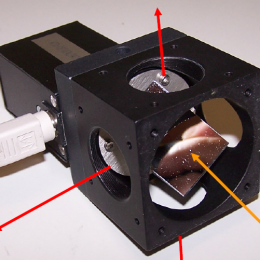
Thorlabs’ 16 mm, 30 mm, and 60 mm cage systems are well known (shown above). The numbers refer to the on-center square spacing of the four 6 mm rods that form the backbone of the cages (4 mm rods in the case of the 16 mm cage system). There are some lesser-known cage systems as well.

Edmund Optics

Edmund Optics recently launched a line of cage system optomechanics. Many of the pieces may fit (or fit with minimal modification) items in the Thorlabs system since they also use 6 mm rods. More broadly, Edmund Optics actually has an excellent line of optomechanics that includes a lot of products that go beyond what Thorlabs offers. For example, these z-axis brackets.

Newport

Here is Newport’s impenetrable cage system. Personally, I think it was a brave choice to hire M.C. Escher as an optomechanical engineer.

Qioptiq

Formerly known as the infinitely more pronounceable Linos, their Microbench and Nanobench lines are excellent. On paper, they should be compatible with Thorlabs 30 mm and 16 mm cage systems, respectively, but in practice I find that there often needs to be just a little bit of modification– e.g., widening holes slightly. Maybe this is due to English-to-metric round-off errors, or different tolerances.

Others

CVI Melles Griot and Siskiyou both have excellent lines of optomechanics, but no cage systems as far as I can tell.

Elsewhere on Labrigger:
Alternative Optomechanics

Numberfactory is a very useful, clean reference site. Unit conversions, formulas, bolts, nuts, screws, and more.

More…
Bolt sizes

Thorlabs and Newport have offered 3D models of their products for a long time. However, they’re typically in formats for expensive programs like SolidWorks and AutoCAD. In the past year or two, Newport has been slowly adding to their library of Google SketchUp models.

I still prefer SolidWorks, but I’m optimistic that I’ll eventually switch to SketchUp. Regardless, it’s nice to see a company supporting free tools.

Fun fact for the day: ThorLabs’ SM2 lens tube standard screws right onto the front end of Nikon’s SLR lenses. Other manufacturers probably use the same threading, I just haven’t tried them.

I don’t know if this is by design or not, but it makes coupling 35mm SLR lenses into optical setups fairly straightforward. I’m using it for a tandem lens macroscope. In the picture above I used ThorLabs part SM3A2. BTW, they also sell some F-mount adapters for connecting to the other side of the lens.

3 comments

Sense of scale

The vast majority of the time, I buy what I intend to. Like the old maxim from construction: “Measure twice, cut once”, I always take care to ensure I’m ordering the right thing. At least when things are expensive. When they’re cheap, I’m less careful. Check out the photo above. I thought, “Sure, that’s the bench vice I’m looking for.” It was so inexpensive, that I went ahead and ordered it without much thought.

I don’t know how big that vice looks to you, but I was surprised when it arrived. Click through to get the sense of scale…
Read the rest of this entry »