Posts tagged with construction

In the early days of patch clamp electrophysiology, everyone made their own patch clamp amplifiers because there were none commercially available. I was lucky enough to be educated by scientists of such lineage, and in one of my classes, as an exercise, we built a simple patch clamp amplifier with series resistance compensation.

Even after patch clamp amplifiers became commercialized, there were still a few aficionados who insisted on their own designs. But very quickly, companies started building so much technology into the amplifiers, that the amps surpassed what an aficionado could practically engineer in their own labs. Although expensive, the amps were affordable and offered a great deal of functionality.

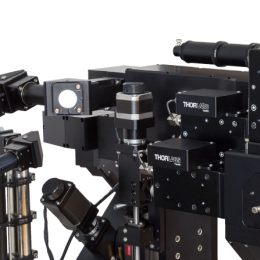
Perhaps 2-photon laser scanning microscopes (2pLSMs) are approaching a similar turning point. With the expiration of the patent on 2pLSM and the flood of commercial interests in the market, including open source designs like the Janelia Farm scope pictured above (link), we are starting to see much more technology being built into these scopes.

Features such as high speed scanning and wavefront shaping are becoming commonplace. Although both of these can easily be implemented on custom built scopes, the pace of “featurization” of scopes is picking up. Perhaps in five to ten years, no one will be building their own scopes anymore because companies are selling such high tech scopes at very competitive prices.

This website is about open solutions for science, but this is primarily motivated by efficiency, i.e., not reinventing the wheel. We’ll keep covering custom 2pLSM information, for now, but only as long as it is practical. We do not anticipate covering how to build a custom patch clamp amplifier, but it could happen.

OpenMoCo is short for “Open Motion Control”. The community is focussed on building rigs for moving cameras.

They have great, detailed, accessible articles on different topics including gearing, motors, and their own software and hardware. They also list several good hardware sources.

It is maybe not a replacement for pipette micromanipulators. However, for stages, microscope platforms, and motorized mechanisms in behavior rigs, this could be a great resource for a custom made solutions.

The have forums too. It’s not the most active community, but it seems to have a steady pace. And perhaps if they broadened their scope a bit, there would be an increase in activity. The infrastructure itself seems very general. Here’s a diagram:

(via)

So you’re feeling pretty good about the rodent virtual reality system (Hölscher et al. 2005) you have up and running. You’ve got it all… the spherical treadmill with motion tracking feeding back into a 3D vector graphics program that projects a first person view onto a spherical screen. It’s a complex system to put together, no doubt. You deserve to feel proud.

Then Lukas Fischer comes along and destroys the grading curve.

Lukas’ blog is a detailed diary of his meticulous design and engineering work as he assembles his mouse VR rig. In addition to narrating the design and fabrication process, he draws raytraces for the optical projection in his CAD illustrations, like so:

His final work resembles the CAD drawings remarkably well.
Theory:

Reality:

He came up with an elegant solution for the spherical treadmill. After an apt dig at over-engineered approaches:

Different techniques have been used in the past to get a good cup for a 20cm or 8in ball. [...] UCL carved it out of a solid block of gold (or so I can only assume given the pricing)

Indeed, UCL’s expensive (about $5700) spherical treadmill, albeit nicely made, is no where near as efficient as Lukas’ solution: a polystyrene sphere inside another, slightly larger, polystyrene hemisphere with air jets. (link, link)

A while back Labrigger covered some sources for alternative mechanics. Here’s a new one. MakerBeam is an inexpensive kit of construction rails aka T-slot bars. This would be a great thing to keep around the lab to construct various riggings. A $130 kit from SparkFun gets you all this:

  • 4x – 30cm beam
  • 8x – 20cm beam
  • 6x – 15cm beam
  • 16x – 10cm beam
  • 8x – 6cm beam
  • 8x – 4cm beam
  • 12x – outside corner bracket
  • 12x – 45 degree bracket
  • 12x – 60 degree bracket
  • 24x – 90 degree bracket
  • 1x – bag of bolts
  • 1x – bag of nuts
  • The MakerBeam system’s best feature may be that the angle brackets are labeled with their angle in turns, a somewhat less used unit than degrees or radians. It doesn’t really matter (1 turn = 360 degrees, obviously), but it quickly ignited an impassioned discussion in the comments of the product page.

    Here’s an excerpt:

    Haha, oh open source. Only you would do something helpful like engrave the angle in each bracket, but render it useless by using some obscure unit…

    (via)
    More Optomechanics Resources

    Scientific research equipment is expensive. Partly because the markets are often small, so product development budgets and manufacturing set up costs have to be split over a comparatively small number of units. In addition, the customers are typically more concerned about reliability and service, rather than price.

    However, there are other markets where these issues are not a concern. These markets are so large, and price driven, that the products are great values. In some cases, these products can be repurposed for scientific research. One market I keep an eye on is audio recording equipment.

    Desks with integrated racks

    One segment that can be repurposed is the furniture, for example, desks with integrated racks for standard, 19″ rackmount equipment. By moving the rackmount equipment to the desk, and getting rid of a standalone rack, the rig’s floor footprint is reduced.

    Omnirax has an extensive line of studio furniture. Purchases can be made directly from their website.

    Omnirax Presto 4
    (about $600)

    Omnirax Force 24
    (about $1400)

    Omnirax’ web site has helpful PDFs showing the measurements of the desks.

    Studio RTA has some inexpensive products.

    Studio RTA Producer Station
    (around $500)

    Studio RTA Creation Station
    (around $200)

    Studio RTA Mix Station
    (around $120)

    Audio interfaces

    Multichannel recording devices have been used as inexpensive DAQs. They have top quality A/D converters, but they’re designed to give basically no DC signal, if that matters in your application. And they may require custom coding, since they’re not specifically designed for use with MATLAB or LabVIEW. Despite all that, they’re still intriguing choices. The 96kHz sampling rate is good enough for most electrophysiology applications. And 8 analog ins and 8 analog outs all running simultaneously at 24 bits of resolution is something that no NI board offers, especially not in a sub-$500 package.

    M-Audio Fast Track Ultra 8R USB Interface
    (under $500)

    Soundproof booths

    Soundproof booths can also be repurposed from the music recording market. I recently visited Mike Wehr’s lab at U Oregon in Eugene. His lab is making beautiful whole cell recordings from auditory cortex in vivo, and he’s found that products like these offer a cost effective way to acoustically isolate a rig.

    Retailers

    Retailers for recording and other pro audio gear: Guitar Center, Musician’s Friend, Music123, Sweetwater

    0 comments

    Raw materials

    If you need a chunk of metal for a custom piece for your rig, what are the options? The best way to go is to buy a part that is close to what you need and then modify it, probably some sort of optomechanics. Alternatively, you can buy a chunk of metal and machine it from scratch yourself. McMaster-Carr is a classic place to get raw materials in US, and Fastenal has a smaller, but similar product line. Online Metals, Speedy Metals, and Metal Express are other places to check. RS is the first place I check in the UK (they’re listed under “Workshop Consumables”, and then “Engineering Materials”). Most of the time, the piece you can buy is woefully oversized for what you need. If you don’t have all the tools in your shop to do the rough shaping (cold saw, band saw, horizontal band saw, etc.), then ask a local workshop to do it for you. This sort of rough work should be dirt cheap with fast turnaround, and it saves you having to buy a whole new tool for your own workshop.

    At the SfN meeting in San Diego this year, I met Jeff Brooker from Thorlabs. Jeff and his team of about 17 people have a history of working together in industry on photonics. They have designed a series of modular pieces for custom 2p rigs. The pieces look great, and the ScanImage team is making a version to work with Thorlabs’ resonant scanner. It’s really high quality stuff, and the modularity means that you don’t have to make compromises to take advantage of their systems. If they price it right, this could be a very popular product line. There’s a bare bones imaging system which includes a deformable mirror for wavefront modification, a prechirper box, and a beam conditioner. And the resonant scanning system, which offers 512 lines at 28 fps, includes an FPGA-based outboard processor to handle the nonlinear scanning.

    Svoboda’s group also presented their open microscope designs. One is a variation on the Sutter MOM scope which allows for better overfilling of large back aperture objectives. The other is a non-rotating design that uses no parts from Sutter. The details are available online. (link)

    On the topic of custom two-photon imaging rigs, what kind of PMTs do you want to go with? Naturally, you’ll order yours to be hand selected for high quantum efficiency and low noise, because you’re such an aficionado, but will you go for the still popular R3896s (pdf) from Hamamatsu, the miniature R6357s (pdf), or the GaAsP H7422s (pdf)?

    Increasingly the answer is the latter. It’s hard to compete with GaAsP PMTs. However, the stock versions do have some annoyances: they switch off during transiently high signals and have to be manually reset, they have bulky cooling systems with noisy fans, and the detector is set back into the body so the field of view is quite narrow. Hamamatsu has heard all of this before and has a number of different variants you can order, but this is not widely known. Here is a summary sheet of all the 7422 variations available (pdf, includes models H10770, H10769, H10771 and H8224). Here are the spec sheets for the uncooled, very wide field of view versions (pdf, pdf).

    The dark count is what skyrockets when you lose the cooling. From 100 or less per second cooled, to 6000 or more uncooled. Of course, even if your dwell time is a relatively long 10us per pixel, this comes out to one extra count every 17 pixels, which isn’t going to kill you in many applications, particularly those with bright fluorescence. Many people run the MOM scope (aka Denkscope) with no cooling on the H7422 PMTs, and they’re just fine.


    I use SolidWorks to design custom parts for my rigs. Many times, these parts mate with existing Thorlabs parts. Fortunately, Thorlabs offers SolidWorks files that can be directly added to an assembly to ensure everything fits. It’s easy to fix relationships between parts (e.g., force a part to slide along posts in the cage system), and determine how everything fits together.

    In the screenshot above, some of you probably recognize the Thorlabs cubes, like Darcy was talking about recently, which are so handy. Here, I use one as a enclosure for a dichroic flipper (custom designed in SolidWorks, then 3D printed), and another in the collection pathway.

    Thorlabs recently broke ground on a new corporate headquarters in New Jersey. They’re clearly doing a lot of things right. I like their easy-to-navigate website, fast shipping, and how they share a lot of technical information on their parts (including the SolidWorks files of the parts as mentioned in this post).

    Post by Darcy Peterka (Columbia University/Yuste lab):

    We do a bunch of multiple imaging/uncaging experiments with 2+ lasers, and got tired of constantly taking apart the camera/laser ports to switch lenses and dichroics. This setup allows easy inspection of the conjugate planes to the sample and back aperture. These are just Thorlabs cubes (C4W) with the kinematic cage platforms (B4C) and dichroics holders (FFM1). They aren’t the most precise pieces, but they are easy to use and align, and are quite flexible. The upper lens off to the left is on a translator to allow easy compensation of the longitudinal chromatic aberration of the microscope for the different colors on the beam paths (~800nm and 1064nm), which would otherwise kill us during our experiments.

    Depending on the objective, laser combo, we may have to move up to a centimeter. Part of the long travel required is because the divergence properties of our 1064nm fiber lasers seem to change more often than we’d like, so we end up doing compensation. I could off-load that task to another telescope, but it is easy enough to change here. Assuming everything is perfectly collimated beams, the difference in axial focus of the 60x 1.1 NA objective is two microns with 800nm and 1064nm light – large enough to screw up experiments with neuronal spines and dendrites.