Posts tagged with calcium imaging

tpp

s1

More open source software to check out.

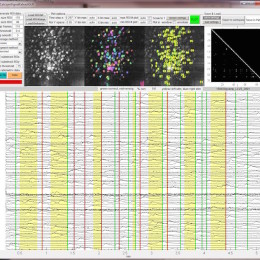
Two-Photon Processor and SeNeCA – A freely available software package to process data from two-photon calcium imaging at speeds down to several ms per frame.
Jakub Tomek, Ondrej Novak, and Josef Syka
TJ Neurophysiol published 10 April 2013, 10.1152/jn.00087.2013

It’s notable in that it is an “all-in-one” package that’s freely available.

The image processing to detect cells and draw ROIs seems to work pretty good, even with poor S:N. I’d like to see it operate on GCaMP images, since those are more challenging in some ways. Cells labeled with Oregon Green BAPTA-1 tend to exhibit spherical patterns of somatic fluorescence, but GCaMP, when it’s working well, does not brightly label the nucleus, so the shape of the ideal ROI is quite different. Plus, it’s nice to pick up dendrites and other features, not just somata.

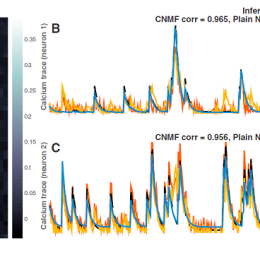
See also, Vogelstein’s code for inferring action potentials in calcium imaging data.

s2

Hat tip to Christian Wilms
EDIT: The code became available shortly after this post.

1 comments

Going back to Cali

calicode

No. I don’t think so.
Anyways, CaliCode is a resource for population calcium imaging. It covers topics from inferring action potential trains from imaging data (hat tip to JV), to image processing and topical papers.

P.S. If you get the reference, check out Game Rebellion’s version.

1 comments

Photoswitchable GECI

Many red fluorescent proteins go through a green fluorescent stage prior to becoming fully folded into their mature red fluorescent state. In fact, some proteins can be photoswitched in and/or out of their mature red state, e.g., Dendra2, EosFP, and Kaede.

Given this protein engineering know-how, perhaps it was just a matter of time before someone made a photoswitchable genetically encoded calcium indicator (GECI). The excellent OpenOptogenetics blog has a post up on the recent report from Robert Campbell and Takeharu Nagai labs (two GECI heavyweights). (link to article)

Roger Tsien’s lab recently published the new generation voltage sensitive dye they were presenting at SfN: VoltageFluors. As often when then Tsien Lab takes on a new field, they start by taking a completely new approach. Instead of designing an indicator based on the previously used voltage detection mechanisms – Stark shift for electrochromic dyes or FRET for hybrid voltage sensors – they use a mechanism found in most commonly used calcium indicator dyes, such as Fluo-4 and OGB-1: photo-induced electron transfer (PET).

In PET an excited fluorophore (e.g. Fluorescein in Calcium Green) is quenched by transfer of an electron from a donor group (e.g. BAPTA in Calcium Green). In calcium indicators, this quenching is only possible if the “ionophore” (BAPTA) has not bound a calcium ion. Binding of calcium shifts the electronic energy levels, making PET unfavorable, ultimately leading to increase in fluorescence. In place of BAPTA, VoltageFluors use an electron rich group connected to the fluorophore via a “molecular wire”. Once the fluorophore is excited, an electron is transfered via the “wire” to the fluorophore, quenching the fluorescence. But (and this is the important part), the electron can only be transfered along a correctly oriented voltage gradient: if the electron donor is in a more negative environment than the fluoropore, electrons can “flow” along the “wire”, quenching via PET occurs, the fluorophore emits dimly. If the voltage gradient is inverted, PET becomes unfavorable leading to an unquenching of the fluorophore, the dye emits brightly.

The advantage of using PET is that the signal to noise ratio is much higher than for both electrochromic dyes and hybrid sensors. Also in VoltageFluors capacitive loading (a big problem with hybrid sensors) doesn’t occur. A further advantage is that VoltageFluors don’t appear to be (photo)toxic, a big problem that has made the use of voltage sensitive dyes difficult in many situations.

No doubt, VoltageFluors are a first generation indicator with lots of room for improvement — this is of course both a strength and a weakness. I for one can’t wait for them to become commercially available.

Post by Christian Wilms. Second figure is also by CW.

Zeiss released an iOS app for viewing spectra.

No Android version yet, but Johannes Amon said:

of course I can’t tell you any specifics but at the moment we are evaluating a native port to
android ICS 4.0. at the end it always comes down to budget so it would help immensely if
you’d order some confocals right now ^^

just joking, gonna keep you posted on this project

It uses George McNamara’s Pubspectra database. (link)

Links: Zeiss, AppStore

Post by Christian Wilms

Call me old-fashioned, but I’m a big fan of small organic calcium indicators (e.g., Oregon Green BAPTA 1). Yes, genetically encoded calcium indicators (GECIs) have many advantages: targeting to specific cell populations, subcellular targeting, etc. But for quantitative, high SNR work, OGB-1 & Co. (ideally not as an AM-ester) is where it’s at.

There are several reasons for this: GECIs have fairly small signal amplitudes (commonly on the level of under 10-fold fluorescence increase from calcium free to calcium bound). They are slow, with on- and off-rates several orders of magnitude slower than BAPTA-based indicators. They are only available in two overlapping hues (green or blue/yellow) limiting the combinability with other indicators and dyes. Finally, the link between [Ca2+] and GECI fluorescence is very non-linear, making quantification difficult.

Not that there hasn’t been any progress over the past decade: the fluorescence increase on calcium binding has steadily increased over the years, the introduction of troponin-C in place of calmodulin as a binding domain has caused a mild increase in kinetics and there have been some preliminary presentations of spectrally shifted GECIs. But all in all, a big jump ahead has not happened yet.

That was the situation until two weeks ago, when Rob Campbell’s lab published an exciting report: Using a bacteria-based high throughput screen, they scanned tens of thousands of randomly generated mutations of GCaMP3. Using this approach they developed a series of GECOs (for Genetically Encoded Calcium indicators for Optical imaging). Among this series is a green fluorescing indicator (G-GECO) with a 26-fold intensity change on binding calcium, a red indicator (R-GECO) with a 16-fold change and a blue indicator (you guessed it: B-GECO) with a more humble 4-fold increase. In addition they developed an emission ratiometric indicator (GEM-GECO) with a flabbergasting 110-fold ratio change as well as an excitation ratiometric indicator (GEX-GECO) with a 26-fold change in ratio.

While the kinetics are still in the same range as those of previous GECIs, the combination of different spectral variants and large dynamic range does address to major limitations of earlier GECIs. Finally, to make a good thing better, the authors will be making all the GECIs open to public access by depositing them at addgene.org.