2p Calcium Imaging Fidelity
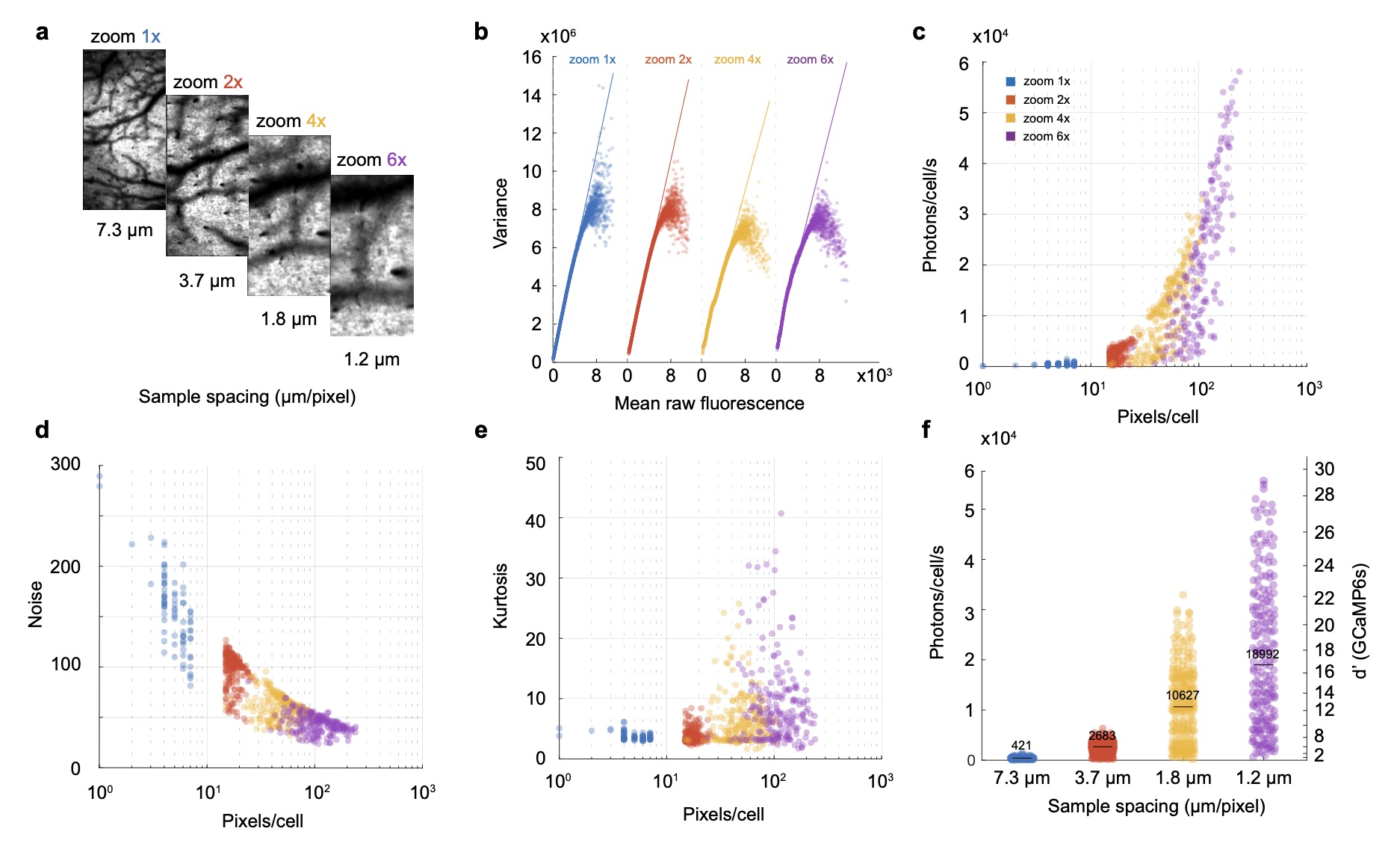
As you all know, if you have a small field-of-view (FOV), you can often get better quality data than with a larger FOV. Dwell times per pixel are higher, more pixels per cell, higher frame rates, and ultimately more photons per second per neuron. That’s the key. You can get contrast and see cells with just a few photons, but to make high fidelity measurements of small changes in fluorescence, you need a lot of photons/s/neuron. Let’s look at this in more detail.
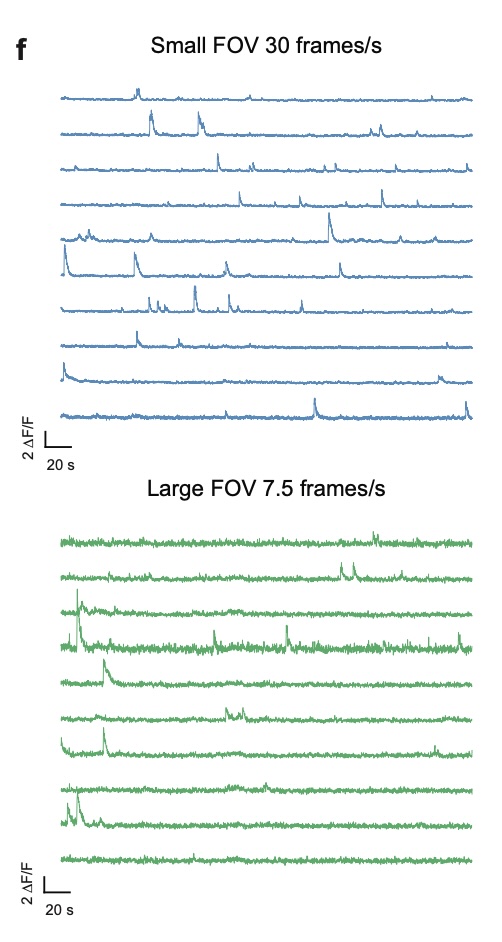
But how to quantify this? We don’t have ground truth spiking data for every single cell. That’s not practical at all. In a moment, I’ll discuss how to estimate the number of photons you’re getting per second per neuron.
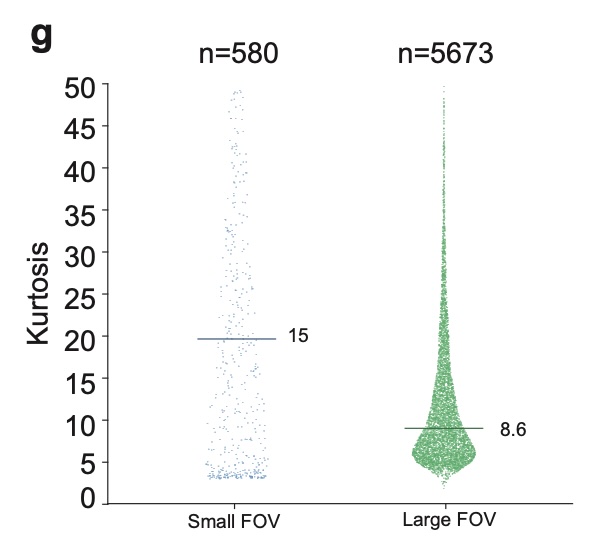
As an aside here, I want to mention that kurtosis is quick to compute, and in practice, it works well to detect high quality data from mouse L2/3 neurons. For example, here are kurtosis values for small and large FOVs. As expected, the small FOV has a higher average kurtosis in the extracted traces. This heuristic is quick-and-easy to compute, and can be a handy metric to guide garbage control (kicking out ROIs that don’t have usable signals).
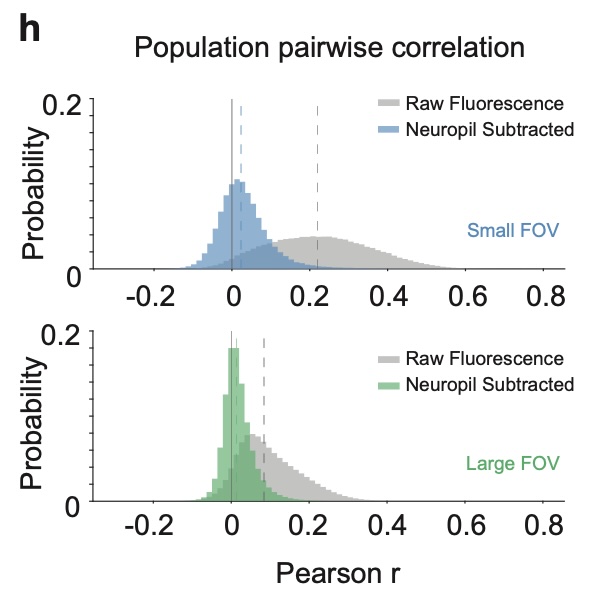
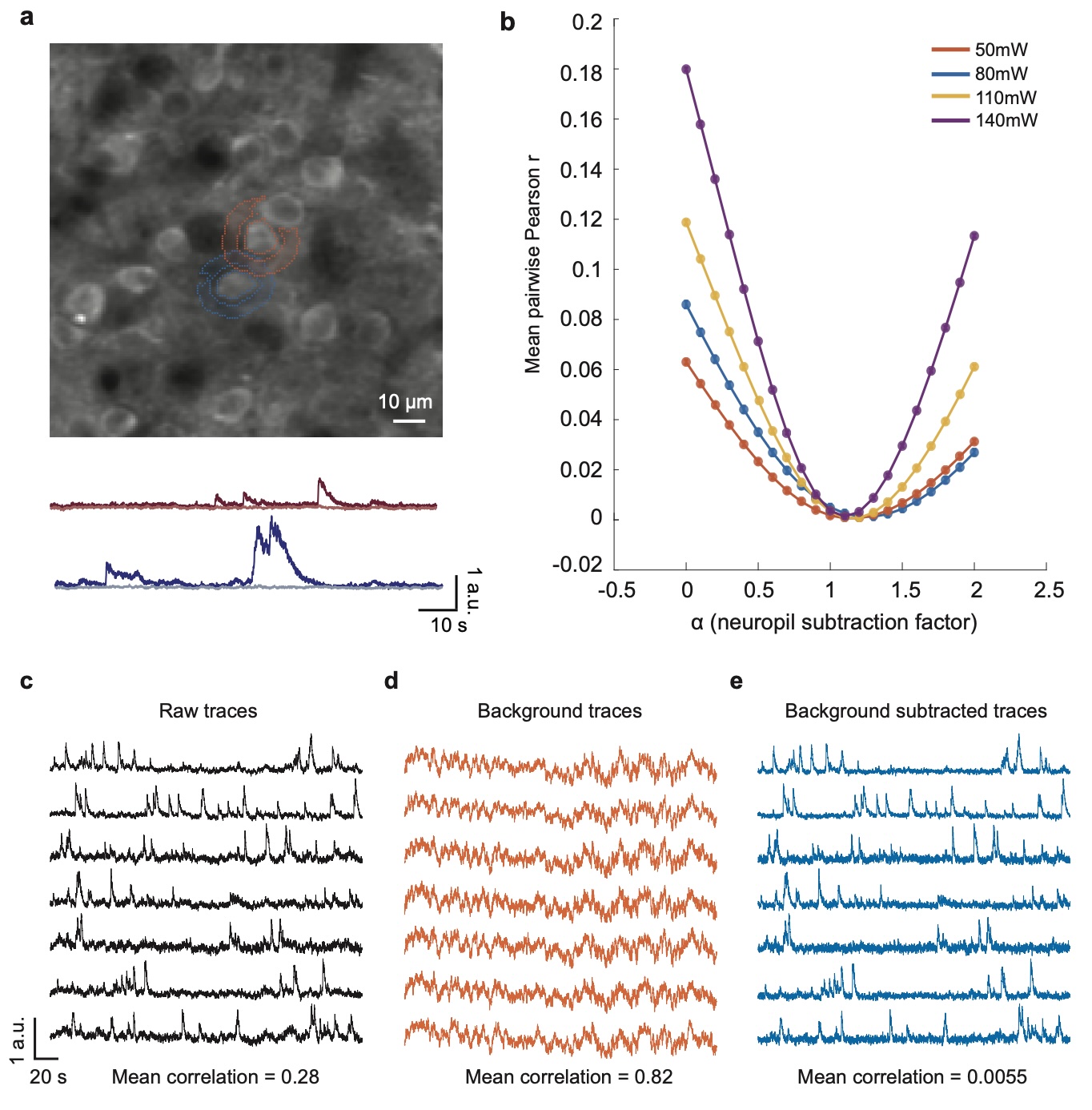
In addition to having enough photons/s/neuron, you also want to subtract the neuropil signal. You can do this with both large FOV and small FOV data, of course. If there’s a lot of neuropil contamination, that can show up as an increased correlation across the population (because the neuropil signal is highly correlated over length scales >> the diameter of an individual neuron.
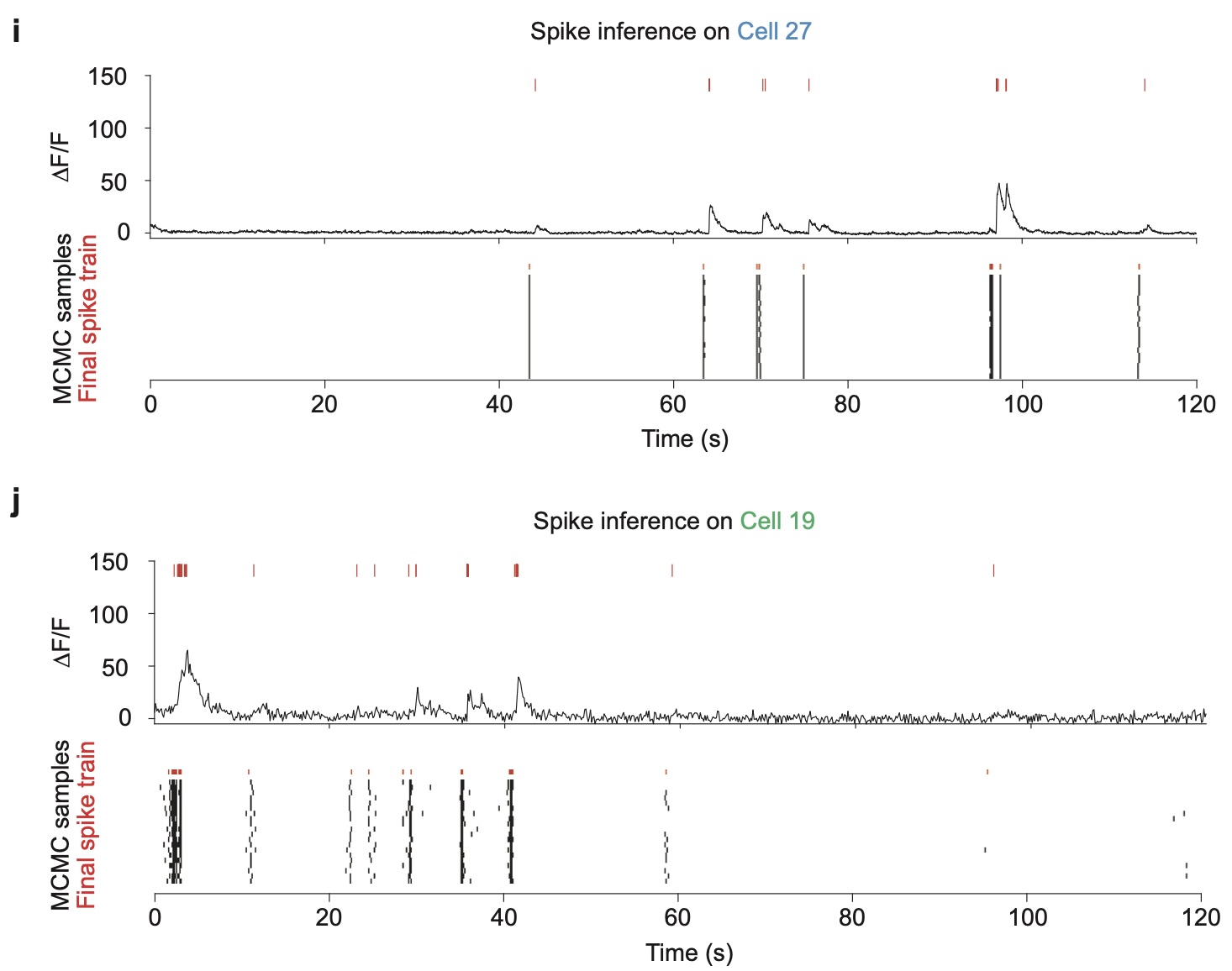
You can also run spike inference on the traces. How about using an MCMC technique, so that you can propagate the uncertainty through your analysis pipeline? Here we use an MCMC approach and look at the reproducibility.
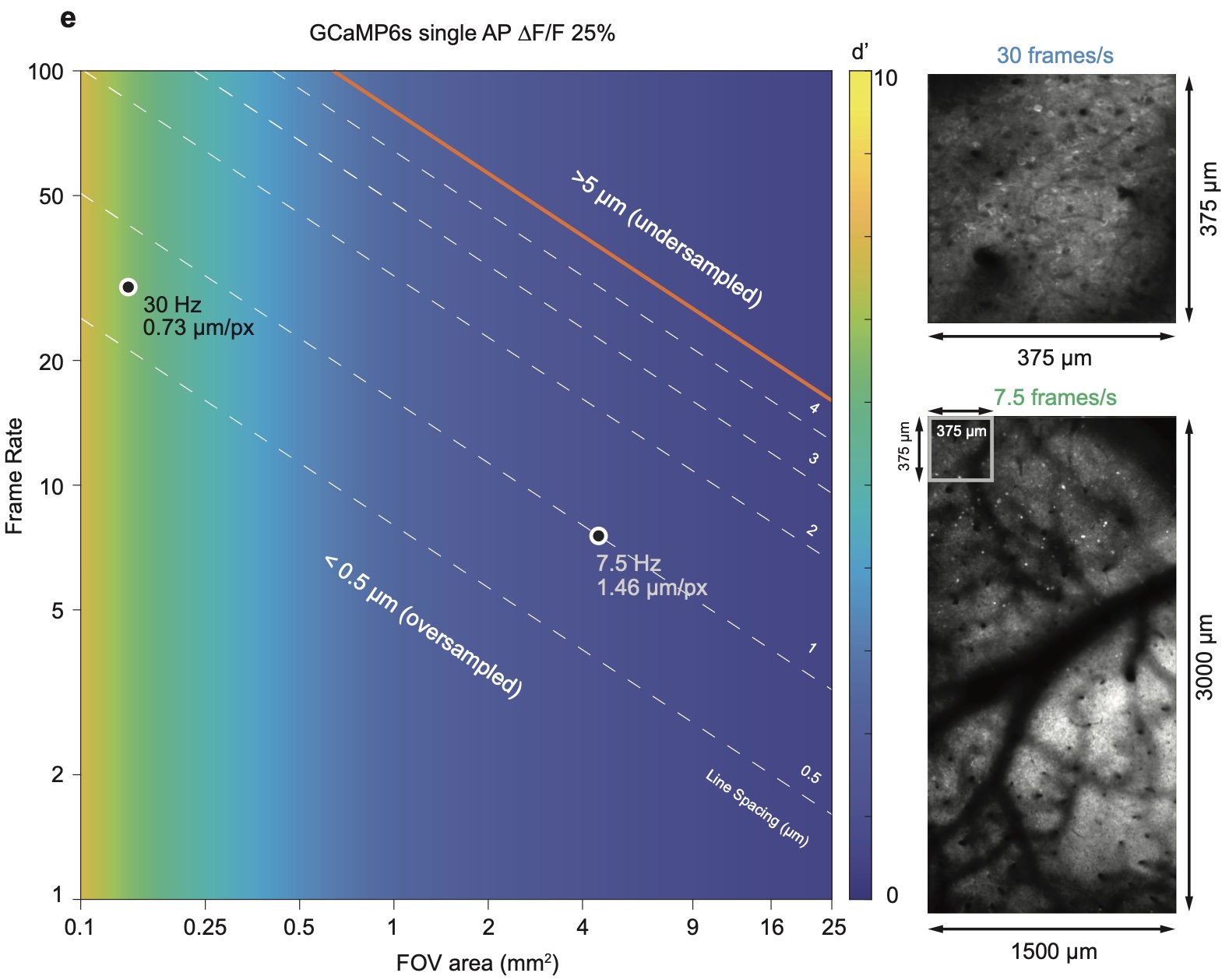
As I mentioned above, the key question is: How many photons are you getting per second (per cell)? We can compare that metric between data from small FOVs and large FOVs, for particular indicators, and experimental parameters. For example:
Filip Tomaska (grad student in the lab) as made a nice online app you can use to explore this parameter space. Try it out!
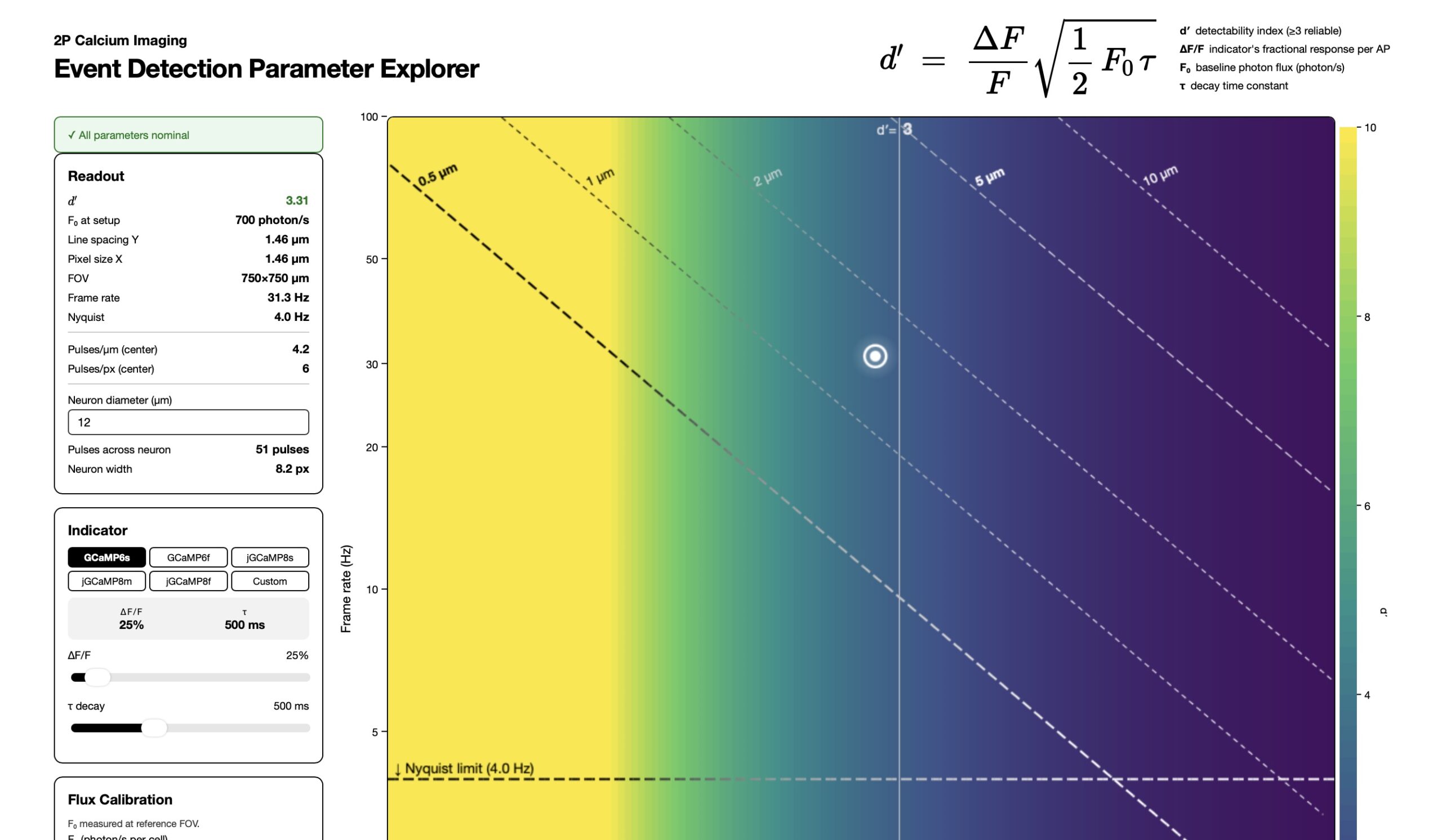
The number of photons you get per second tells you how sensitively you can detect events of a particular dF/F amplitude. Wilt et al. 2013
To determine how many photons you’re getting per cell per second, you need to estimate the number of photons your pixel values correspond to. I wrote about this many years ago on Labrigger.
Filip Tomaska has also developed an app you can use to estimate this yourself, and examine your data quality. Try this one out too!
How do you get more photons/s/cell? Using a bright indicator with slow dynamics, like GCaMP6s. Using an optimized imaging system (small axial PSF for excitation, short pulses at the sample plane, sensitive detection) can help too.
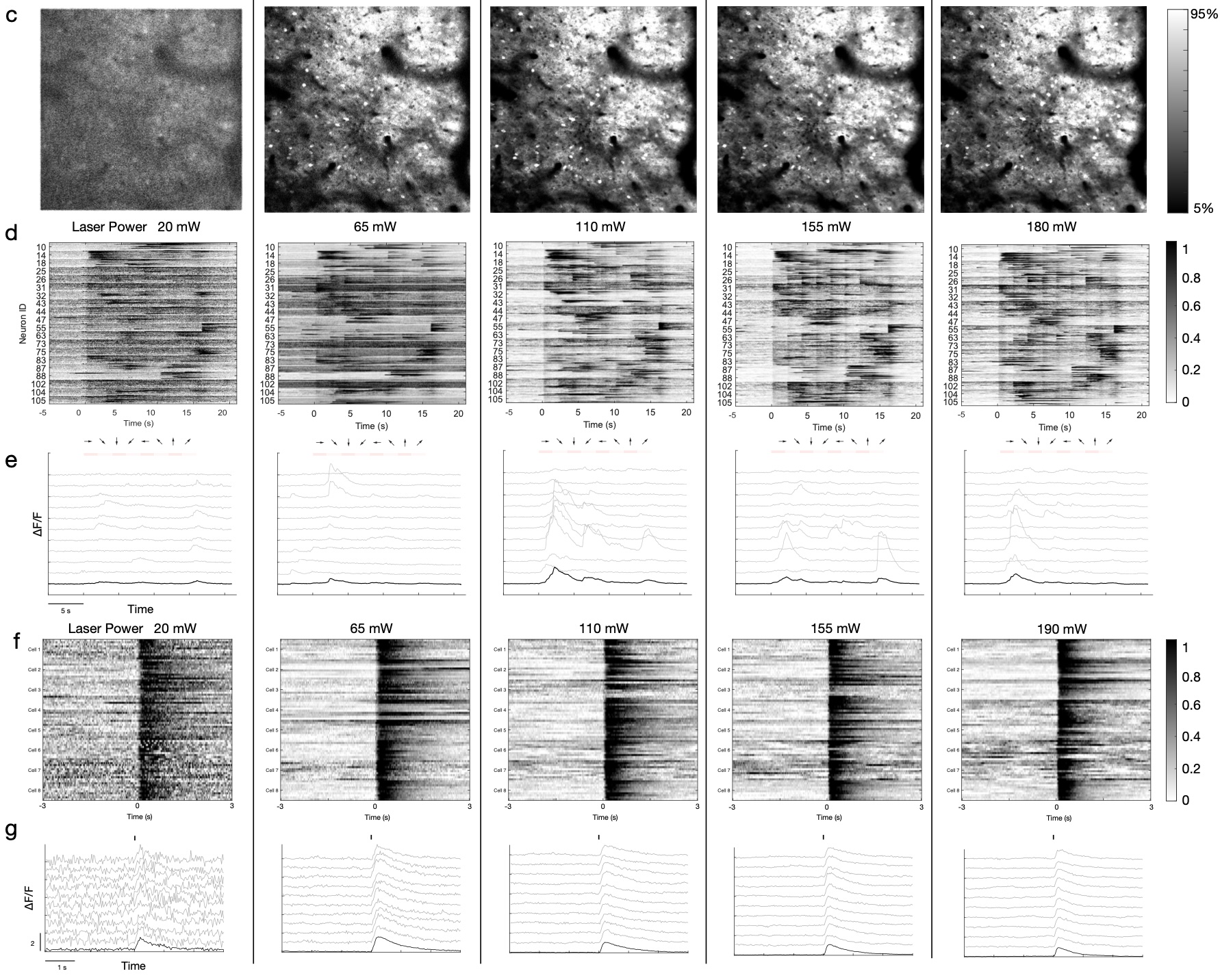
You can also increase laser power, but there are diminishing returns after a point. In this experiment, more than tripling the power from 20 mW to 65 mW helps. But nearly tripling it again to 180 mW doesn’t buy you as much. It seems like data quality levels out at around 110 mW.
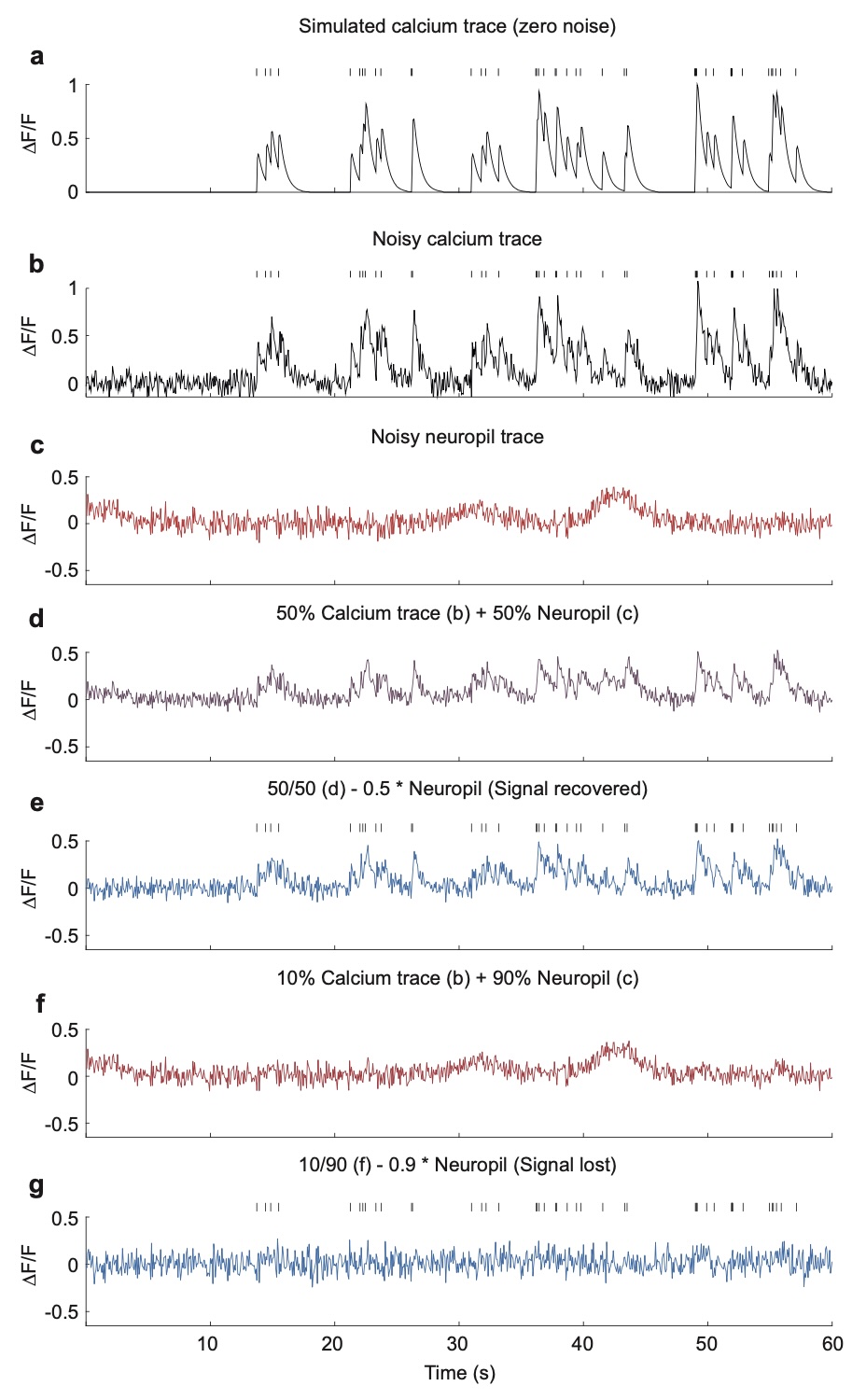
It’s not just about getting enough photons/s/cell. You also need those samples to be high quality. As mentioned above, we want to subtract the neuropil component, and to be able to do that, you need to have a measurement from the neuron that isn’t completely swamped by neuropil. A 50/50 mix is usable. But if the pixels in the soma of the neuron are 90% neuropil signal and only 10% neuron signal, even with subtraction the neuron signal can be lost in the shot noise.
Also mentioned above, when you subtract the neuropil signals from neurons, the correlations among neurons decrease. If you over-subtract the neuropil signal, then you end up getting correlations among neurons again because you have a big shared signal showing up in all of their traces. We can use this to pinpoint an optimal neuropil subtraction factor. We find that it is typically higher than the 0.7 factor that is commonly used. Your results can be different.
To bring it all home… as you zoom out to look at larger numbers of neurons simultaneously, you get fewer photons/s/cell and your ability to detect small events decreases. But you can monitor this. You can measure it. You can make optimizations in sampling, power, pulse shaping, etc. to make sure that you have enough photons/s/cell to do the experiment you want.