Structured illumination
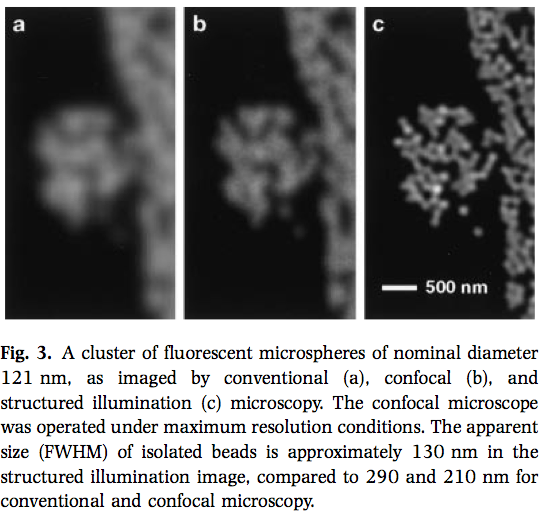
Structured illumination can be used to increase the resolution of wide field fluorescence imaging. The idea is best motivated by thinking about Moire fringes. In panel (a) below, if you stand away from the screen at some point the two gratings will appear each as gray panels rather than gratings. Thus, this low spatial frequency pattern is revealing information that exists beyond the resolving power. This technique can offer at least a doubling of spatial resolution, and in the presence of nonlinear saturation effects, can theoretically offer unlimited resolution.
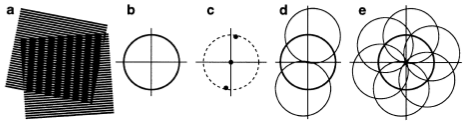
This technology was pioneered by Mats Gustafsson. I briefly met Mats at a conference in 2006. We corresponded via email and he was generously helpful as I planned out building my own structured illumination rig. Mats’ lab is now at Janelia Farms.
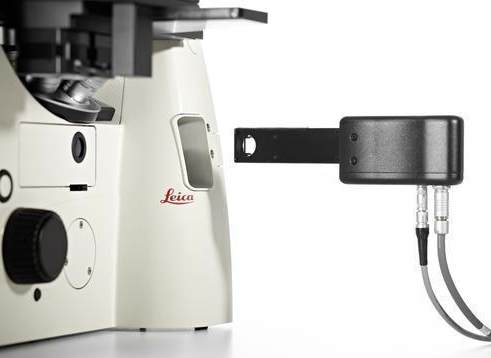
This blog is about open solutions, and maybe someday in the future I’ll post more about building your own structured illumination microscope, but today I wanted to highlight this technology and point out that Leica is offering a turnkey solution for structured illumination (link).
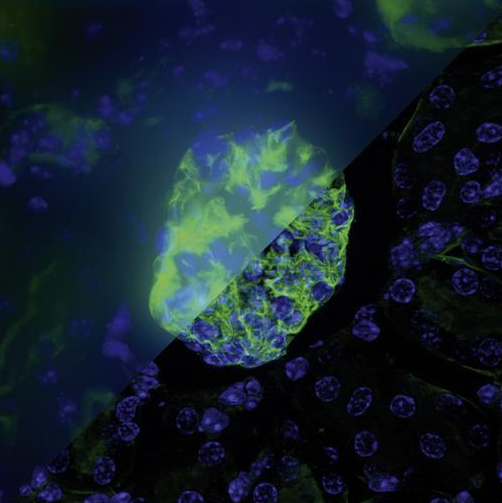
Nice post. Just a short addendum: Zeiss also has a turnkey structured illumination add-on to their scopes:
http://www.smt.zeiss.com/C12567BE0045ACF1/Inhalt-Frame/1268311E3AF7907AC1256C30004625B5
Have you (or anyone) posted/published a plan for adding structured illumination to a standard wide field fluorescence scope?
thanks
I don’t know of a published plan, but I’ll share some info in an upcoming post.
Thanks for the tip, CW. That helped me find a paper that compares confocal imaging with wide field structured illumination (Zeiss’ ApoTome that you linked to). http://www.ncbi.nlm.nih.gov/pubmed/19256710
It should be noted that neither of these commercial systems implement the super-resolution technology described above. Rather, they are simply the widefield optical sectioning version. Perhaps we will see Gustafsson’s approach implemented in commercial systems soon.
Just heard back from Mats. Super-resolution structured illumination scopes have been announced recently by Zeiss, Nikon, and Applied Precision.
http://www.zeiss.de/c12567be0045acf1/Contents-Frame/1736b900a71d4300c125758d0021d760
http://www.nikon.com/about/news/2009/1203_n-sim_01.htm
http://www.appliedprecision.com/superres/overview.asp
[…] of the early posts on this blog was about structured illumination. Specifically, I spoke about Mats Gustafsson’s version, which yields superresolution imaging, […]
[…] on Labrigger… Structured illumination Notes from an email exchange with the late Mats Gustafsson, a pioneer of structured illumination […]