Axial resolution and numerical aperture, part II
To recap the previous post on axial resolution and numerical aperture in two-photon microscopy:
For excitation deep in scattering tissue, higher NA can actually be detrimental because the light cone at the periphery has to travel a longer distance through the scattering tissue compared to moderate NAs. In addition, spherical aberration is more of a problem at higher NAs.
To increase axial resolution, first ensure that you’re overfilling the back aperture of the objective before trying a higher NA objective. A 0.8 NA objective’s axial resolution is only about 50% broader than a 1.0 NA objective. By contrast, underfilling the back aperture significantly makes the axial resolution broader by 200% or more. So before buying a higher NA objective, ensure that you’re actually using all of the NA in your current objective.
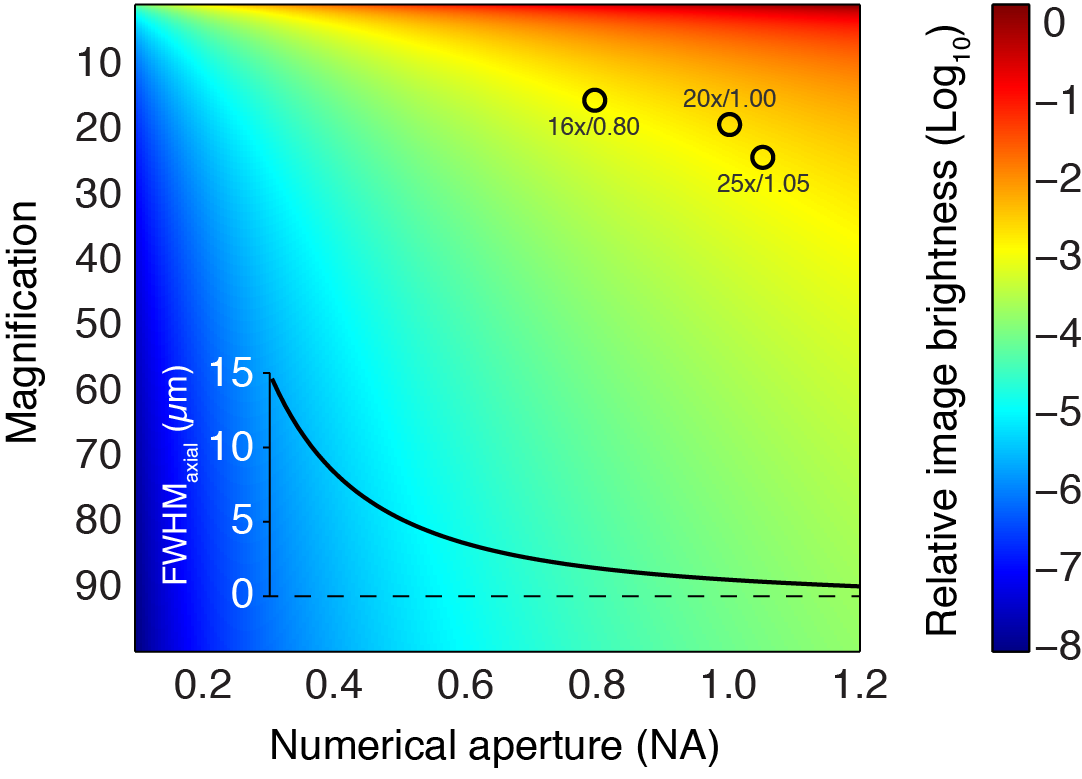
For collection, high NA is good, but so is low magnification. For example, a 16x 0.8NA will collect more scattered fluorescence signal than a 63x 1.0NA. A rough image brightness factor can be computed to compare among objectives: average transmittance of visible light * (NA^2/mag)^2
The figure at the top of this post summarizes the brightness factor for a range of different NAs and magnifications*. Several objectives are noted on it as well. At the bottom is the relationship between NA and axial resolution (theoretical best, ref).
Optimal: So what has been recommended for years is to use a high NA objective and underfill it a bit.
In two-photon population calcium imaging, the neuropil response can contaminate neuron responses. This happens when the axial resolution is poor, such that the excitation volume extends out of the soma. This often occurs when the back aperture of the objective is underfilled, resulting in a lower effective NA.
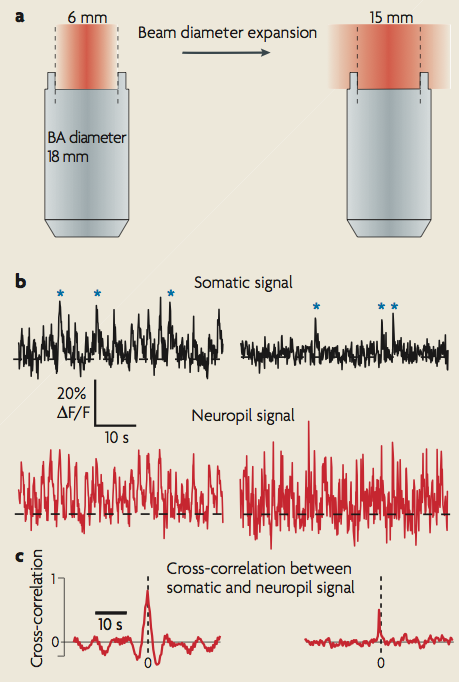
Here’s the relationship between numerical aperture and neuropil contamination.
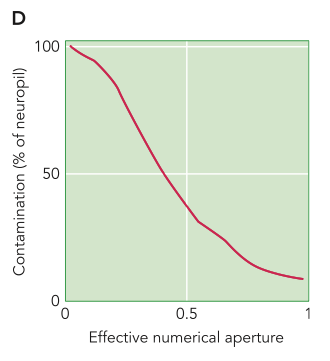
The influence of neuropil contamination is partially dependent on the signal-to-noise (S:N) of the somatic spike-associated calcium transients. If S:N is high, then a small amount of neuropil contamination can be negligible.
More info:
Part I of axial resolution and numerical aperture
High NA, low mag objectives
* I’ve omitted the transmission characteristic in these calculations. Although IR transmittance varies considerably among manufacturers, in the visible range transmission is consistently around 85% for water dipping, low mag, high NA objectives. Thus the relative measures are unaltered.
There is another aspect to this that I have been wondering about for a while: Two-photon excitation requires photon of identical polarization angle. High NA objectives depolarize the light as it is focused. This suggests that high NA objectives should be less efficient at 2P-excitation. I haven’t been able to find any literature on how pronounced this effect on excitation efficacy is, but I would expect it to set a clear upper limit on NA usable for 2P excitation.
First of all I’d like to thanks you for this contribution, very helpful.
I did not know that the magnification affects the transmittance, could you maybe explain me why this happens? If the NA is the same the same cone of light is captured by the objective right? Where exactly is the light lost then in higher magnification systems?