The Labrigger 2p Calcium Imaging Catechism
1: Are you getting enough photons/s/cell ?
- Select an indicator.
- Determine what you want to measure: Do you need to see every spike? Or is detecting bursts enough?, and what minimum deltaF/F that corresponds to for your indicator.
- Find the decay time for your indicator.
- Pick the d-prime level at which you want to detect those events.
Then set your imaging parameters according to the baseline F you need to have.
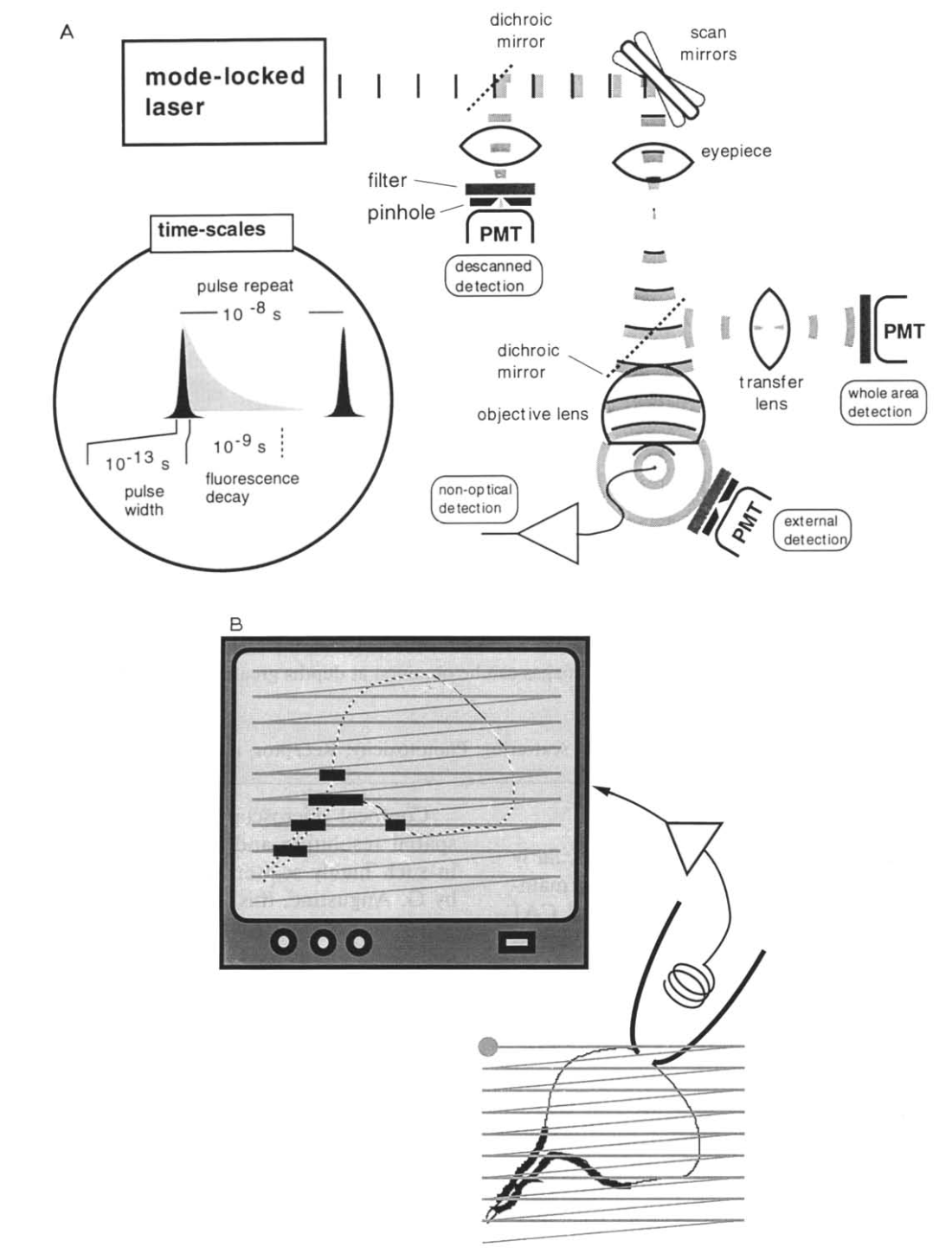
That will be a number of photons per second per cell. Typically on the order of 1000 to 10,000 photons/s/cell. You can estimate how many photons you’re getting by estimating the gain of your system. You can increase the number of photons/s/cell by increasing the laser power (to an extent), optimizing the pulses (adjusting prechirping, etc.), increasing the number of pixels per cell, increasing the dwell time per pixel, etc.
2: Are your photons/s/cell dominated by an individual neuron and not swamped by neuropil?
• Take data and compare neuron ROI traces with nearby neuropil ROI traces. Lower correlations indicate lower neuropil contamination in the neuron ROI.
• Use neuropil subtraction and examine neuronal correlations in the population.
Population level average correlations are lower when the neuropil contamination is effectively removed.
One can use small PSFs and/or sparse labeling at first. These conditions can be relaxed if the data quality indicators above are not degraded.