Posts tagged with references

Laser pointers are handy sources for coherent light. The green and blue varieties are actually diode-pumped solid state lasers, all in a hand-held package. The IR wavelengths used for pumping are typically left in the beam, so your green laser pointer is actually a fairly bright IR laser with some green thrown in.

This was discussed in a NIST technical note (arXiv). Here’s the spectrum for a green laser pointer they measured. Note that it’s way hotter in the IR than in green.

Besides imaging and aligning optics (and, apparently, pointing), they’re useful for demonstrating different physical properties of light.

I rather enjoyed rpg’s post on using a laser pointer to investigate the wave nature of light. Key quote: “So the wavelength of my laser is about 500 nm. Seeing as it’s rated as 532 nm and I’m a biologist, I’d call that a result.” The basic idea is to replicate Young’s classic double-slit experiment using a laser pointer as the coherent source.

It reminded me of this old Scientific American article about how you can make your own Quantum Eraser.

0 comments

Pubmed limbo

In my experience, PubMed works beautifully the vast majority of the time. It does an excellent job parsing search terms and they’re always adding new features (e.g., you can search using full names now, not just first initials). PubMed works so well, that I’m actually surprised when it fails to find the paper I’m looking for. But it does happen.

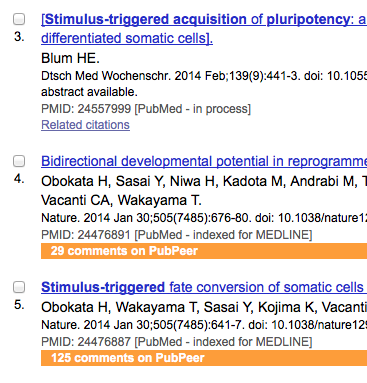
LSTOTT has a great post about articles lost in PubMed limbo. It’s a real phenomenon. They also identify an article which is in the database, but does not get returned using standard searches that should match. Which happens more often, in my opinion.

Database jocks call this latter problem an indication that recall < 1. (The former problem is just a mistake in QA, that is, someone forgot to include the article). This is the proportion of relevant documents that are actually returned. LSTOTT thinks PubMed’s recall may be declining (they call it “leaky”). What do you think?

Google Scholar does an excellent job of finding well-cited articles, including the ones PubMed misses. This is because there is no one point of failure that can prevent indexing: if the article is cited, then Google will index it. But this strength is also its weakness: relevancy is often sacrificed in favor of citation counts. Furthermore, the output is ordered by citation counts, which is not typically a useful parameter when I’m searching for a paper. PubMed’s reverse chronological ordering is better. But really, both systems should make it easier to re-sort the results.

2 comments

Laser safety

A recent discussion on the confocal listserv reminded me of the very nice section on laser safety in Sam’s Laser FAQ. (link)

A gem is this comparison between the power per unit area (on the retina) of the sun compared to that of a 1mW laser (many laser pointers are stronger than this):
Sun = 0.1 watts/mm2
1mW HeNe laser = 16.7 watts/mm2
Over 167 times the power of the staring at the sun!

And it only gets worse: your Ti:Sapphire laser is outputting 3000 times the average power of that 1mW HeNe. The photo above is what happens to the retina faster than you can blink. Please be careful.

Disclaimer

Fiber optics must be terminated properly in order to permit high transmission. If you’re making your own, get a proper fiber cleaver and a set of polishing sheets. Here are a few good references: ThorLabs, LANshack, Datacottage

On the subject of fiber optics, I had a conversation with someone at our recent single cell electroporation workshop about running pulses from a Ti:Sapph laser through a fiber. It is possible to do so, without massive pulse dispersion, using a hollow core photonic band-gap fiber (ref, ref). It can also be done with a single mode fiber, but requires more kit (ref).

I recently had the pleasure of visiting Garret Stuber’s new lab at UNC-Chapel Hill. He has an exciting program going with optogenetics and I was impressed with the high quality fiber optic work in his lab. They’re really doing everything right.

It’s difficult to track down 2p absorption cross sections for dyes and proteins. Doing it right requires (ideally) fluorescence lifetime imaging and Strickler-Berg analysis. Here’s an example, measuring the 2p absorbance cross sections for orange and red fluorescent proteins: Drobizhev et al. 2009.

However, most people just aren’t set up for that. Many labs will make comparison measurements for their own reference, just plotting brightness versus excitation wavelength for a fixed average power (we’re biomedical scientists, not spectroscopists after all). This is useful, but not publishable, and thus not shared. So everyone ends up doing it themselves, effectively wasting a bunch of time.

Just the other day I checked out a few far red dyes (Atto 647, Atto 633, and Atto 611) and didn’t find them useful for 2p microscopy. Instead of keeping this to myself and letting everyone else figure out for themselves that they aren’t useful for 2p, let me save you the time.

Alexa 594 was my baseline. It’s a nice bright red dye– the broad side of a barn, in terms of 2p cross section. Unfortunately, the far red Atto dyes I compared it to were very dim. Here’s the graph. Next to their names, I’ve written the quantum yield (qy) and extinction coefficient (ec) for each dye (1p fluorescence measurements, from the manufacturer).

Normal fluorescence spectra

By the way, 1p spectra are all over the place. Here are some handy links:
Invitrogen’s Spectra Viewer
BD Biosciences’ Spectra Viewer
Boswell & McNamara’s Spectra Viewer
Pubspectra (link) (link)

I follow quite a number of RSS feeds, but there are some news sites that don’t have them. In order to keep up to date, use Page2RSS.

For example, if Nature Neuroscience didn’t have an RSS feed for their Advanced Online Publications (AOP), you could make your own. Copy and paste this link into your RSS reader.

Jim Pawley upgraded the 39 Steps from a simple MacGuffin to a classic checklist for troubleshooting fluorescent microscopy images. Now 10 years old, it remains very relevant. It covers thirty-nine different parameters to check: from singlet state saturation to embedding medium. It’s a good place to start if you’re puzzled as to why your images don’t look as good as you expected.
Jim Pawley’s The 39 Steps (thanks to CW for the tip)

On a related note, if you’re in London, the stage production of The 39 Steps at the Criterion theater is a great comedy to check out.

BTW, here are the online microscopy and imaging references from the major microscope manufacturers. These can also help in troubleshooting.
Olympus Microscopy Resource Center
Nikon’s Microscopy U
Carl Zeiss MicroImaging Online Campus

Don’t forget catalogs as textbooks!

Physicists have a very unsentimental way of manhandling mathematics. In addition to setting up dimensionally inconsistent equations for order-of-magnitude estimations, they like to take lots of short cuts that make computations fast and easy. For example, in the Hartree atomic unit system, several fundamental quantities are all set equal to 1. Electron mass, electron charge, Planck’s constant, and Coulomb’s constant– all are set to 1. One time, in the middle of a derivation, my plasma physics professor crossed out a 2 and wrote 1, saying, “in plasma physics, 2 is 1; sometimes 10 is 1; 5 is always 1.” Another trick was expressing the number of seconds in a year as pi * 107; this is accurate to better than 0.5%!

The book “Street-fighting Mathematics” by Sanjoy Mahajan (MIT Press) teaches a lot of tricks like these. Plus, Mahajan does an excellent job of training the reader in how to approach physics problems and apply logical shortcuts. Check out some of the material using MIT’s Open Courseware site.

Many manufacturers distribute catalogs that include extensive tutorial sections. You could really teach a pretty extensive engineering course on optics using nothing more than the front pages of the CVI Melles Griot catalog. In this post I’ll point you to some of these resources.
Read the rest of this entry »